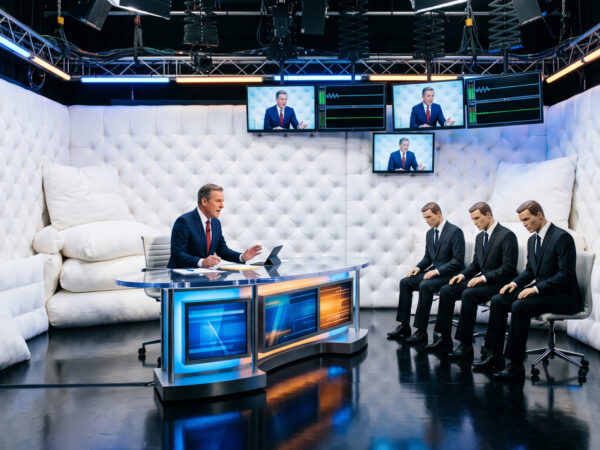
Baltimore County Executive Campaign Coverage 2022 vs. 2026
The Fixed Rig of Corporate Media Gatekeeping
The multi-million-dollar legacy media institutions operating across Baltimore County love to posture as neutral arbiters of public information. They run slick promotional campaigns claiming they exist to serve local neighborhoods, inform voters, and keep the democratic process transparent. But a cold look at the numbers exposes a vastly different reality. The corporate newsrooms on Television Hill function as aggressive political gatekeepers, actively deciding who gets a public platform and who gets completely erased from the civic conversation before a single ballot box opens.
When you juxtapose the absolute media blackout of the 2022 Baltimore County Executive Democratic primary against the saturated, red-carpet coverage of the 2026 cycle, the corporate bias transforms from an underlying theory into an undeniable fact. The corporate press doesn’t allocate airtime based on legal ballot qualifications or community relevance. They allocate it based on institutional alignment, campaign war chests and insider access.
The 2022 Blackout: Erasing an Independent Voice
Let’s be completely clear right out of the gate: you are damn right I have sour grapes about how the 2022 election was handled! Imagine a brand-new business opens its doors in a tight-knit community. The owners invest their own sweat equity, lay down their capital, meet every local regulatory requirement and open up shop ready to serve the public. Now imagine the local newspaper and television stations collectively decide to act like that business simply does not exist. They refuse to review it, they won’t print its name and they don’t include it on any local maps. That is not standard market competition–it’s a deliberate, coordinated boycott designed to starve that new venture of oxygen.
That is exactly how the major media monopolies treated the 2022 Democratic primary when an independent challenger from Dundalk stepped up to break the status quo. The establishment loves to hide behind lazy excuses, claiming they have to prioritize limited airtime because an election field is too crowded with fringe candidates. But that logic completely collapses under the weight of the actual 2022 ballot metrics. In many ways, that year was a social experiment for Baltimore County residents.
- The Reality of the Field: It’s not like there were six or seven confusing people cluttering up the race. It was just two primary election Democratic candidates. A clear, one-on-one choice between an entrenched incumbent and a grassroots outsider.
- The Infinite Airtime Paradox: The major network affiliates have hours upon hours of daily broadcast programming to fill across their morning, afternoon, and evening slots. Their reporters, camera crew and everyone back in the station wake up at the ass crack of midnight to broadcast around 4 or 5 AM. They possess a massive, continuous spectrum of public airwaves for many hours each day of the week. Yet, they could not carve out a single thirty-minute block to let the taxpayers hear a head-to-head debate.
Pardon the third person perspective coming up…it’s necessary. The specific question of how many times challenger Adam Reuter’s name was mentioned in big media outlets between February 2022 and July 2022 yields a definitive, documented metric:
Absolute zero.
Major corporate broadcast operations–including WBAL-TV, WJZ-TV, WMAR and WBFF Fox45–completely frozen out the race, dedicating zero news segments or policy interviews to the active primary contest. Print giants like The Baltimore Sun and The Baltimore Banner followed the exact same blackout protocol. The challenger’s name was buried deep within sterile, automated candidate listings published by the State Board of Elections, stripped of all qualitative analysis or journalistic context.
The Banner were probably the disappointment. They launched in 2022 with a massive multi-million-dollar bankroll and endless promises to rescue local journalism. They postured as a fresh alternative to the dying legacy monopolies. But the newborn newsroom fell straight into the exact same corporate cash trap before their digital ink even dried. Their wealthy boardroom executives immediately prioritized institutional clout, access-driven reporting and big-money donors over real grassroots coverage. They completely ghosted Adam Reuter from their 2022 coverage windows, choosing to protect their political relationships instead of informing the public. They proved that a new logo changes absolutely nothing — dollar signs dictate the news judgment in Baltimore every single time.
Back to TV Hill. The corporate gatekeepers completely refused to air or cover a single debate or candidate forum for the Baltimore County Executive primary during the entire 2022 cycle. While they happily funded and produced prime-time broadcast hours for statewide races, they unilaterally decided that the county’s highest office was an uncontested coronation. By denying the public a televised stage, the media insulated the incumbent from defending his record on developer impact fees under bills 16-19 and 41-19, or facing direct cross-examination on major administrative procurement scandals.
This also happened during the general election as well. One debate was held and WBAL-TV gave it a couple minutes in a news package coverage but that was it. Credit where it’s due, that is better than nothing. The other three TV stations didn’t give two shits about a race affecting 800,000+ residents.
The corporate press preferred to act as the political opposition themselves, running independent investigative pieces on the administration’s controversial $4.2 million Peterbilt dump truck purchase or the Green Spring Valley zoning favors exposed by the Inspector General. They completely cut the actual primary challenger out of the loop, using his name only retroactively as a single-sentence transitional clause to summarize the incumbent’s inevitable victory.
When CBS Baltimore finally dropped a post-election wrap-up, their complete lack of basic journalistic standards hit a new low. They couldn’t even bother to copy my name verbatim off the official ballot — instead printing it as “Ivan Reuter” while butchering County Executive Johnny Olszewskis last name in their own web address and headline.
Despite this total lack of media stimulation, televised exposure, or corporate backing, the grassroots reality broke through the static. On primary election day, outsider Adam Reuter managed to still capture 12,656 votes, pulling 13.57% of the Democratic electorate. Over twelve thousand local taxpayers walked into a voting booth and explicitly rejected the incumbent, choosing a name they had to research completely on their own without a single shred of assistance from the Television Hill monopolies.
The Institutional Exceptions
It is a matter of historical record that the media blackout was not 100% total, but the outlets that actually stepped up to do real journalistic work further highlight the bias of the corporate giants. While the multi-million-dollar broadcast stations looked the other way, alternative platforms actually bothered to give the public a choice:
- WCBM 680 AM: The local talk radio station broke the corporate blockade by bringing the independent challenger on the air, allowing an open microphone to discuss government transparency and accountability directly with the working-class audience.
- WBAL Radio’s The Kim Klacik Show: Even within the broader legacy radio framework, individual syndicated programs like Kim Klacik’s show recognized the value of actual electoral competition, conducting a live interview with the challenger.
- The Patch (Perry Hall): Niche digital neighborhood networks like The Patch recognized that local government matters to local communities, publishing a dedicated campaign story to detail the platform of the outsider candidate.
Because these alternative outlets are not considered “major media” by the political class, the establishment completely ignored their coverage. The major television networks operated like if a candidate didn’t exist on their specific broadcast signals, they didn’t exist at all.
Now, you may ask why I didn’t provide my own video coverage of the candidate forums since there are some broadcast quality high definition cameras in the arsenal? I tried…cameras weren’t allowed into the private events! I did manage to make a bootleg audio recording at one of them, but that was it.
The 2026 Red Carpet: The Open-Seat Media Frenzy
Fast-forward to the 2026 election cycle and the corporate media apparatus has turned around like an illegal Baltimore U-Turn. Because there is no incumbent gravity to protect, the major networks have completely abandoned their 2022 silence, unleashing a massive torrent of prime-time coverage, candidate profiles and heavily produced public debates.
The comparative data from the period of January 2026 through June 1, 2026, exposes an entirely different tier of institutional treatment for the chosen Democratic candidates:
- The Televised Circuit: The 2026 field has already been handed multiple high-profile platforms. The League of Women Voters hosted a comprehensive forum at Goucher College on March 26, which was widely streamed to the public. This was quickly followed by a dedicated economic forum hosted by the Greater Baltimore Board of Realtors on April 29.
- Prime-Time Town Halls: The absolute peak of media investment occurred on May 15, 2026, when WBFF-TV (Fox45) broadcasted a full, prime-time “Your Voice, Your Future” televised Town Hall debate. The network cleared its lucrative commercial scheduling to let candidates like Julian Jones, Izzy Patoka, Pat Young, Nick Stewart and Mansoor Shams square off live on-air over public safety and Towson crime data.
- Continuous Earned Airtime: Major networks like CBS News Baltimore and WBAL have routinely brought these candidates into their studios for soft, policy-driven interview segments. Corporate candidates like Nick Stewart are given uncritical, premium afternoon blocks to pitch their campaign brochures directly to a county-wide audience, framing their corporate law backgrounds as a “fresh start” for the jurisdiction.
The Structural Contrast: Capital over Community
The corporate television conglomerates love a high-stakes cash race because it helps them rake in money on campaign commercials. The 2026 filings show Julian Jones raised a staggering $1,347,879, while his council colleague Izzy Patoka pooled $1,118,000. Even political outsider Nick Stewart reported a hefty $710,080 war chest. TV Hill hacks only care about heavy capital and corporate law connections. They track who holds the million-dollar treasuries and reward those chosen insiders with free broadcast exposure because they are labeled “viable candidates”.
When you lay the raw metrics of 2022 and 2026 side by side, the systemic corruption of the media gatekeeping process becomes completely undeniable. The core difference in how these two elections were covered has absolutely nothing to do with news value or civic importance–it has everything to do with campaign capital and insider status.
| Media Coverage Comparison Metric | 2022 Democratic Primary | 2026 Democratic Primary |
| Number of Candidates on Ballot | 2 Candidates (One-on-One) | 5+ Major Candidates |
| Televised Prime-Time Debates | 0 Broadcast Blocks Provided | Multiple Broadcasts (WBFF-TV Town Hall) |
| Challenger Media Mentions (Critical Window) | 0 Dedicated Packages across Big 4 | Dozens of Profiles, Interviews, & Analyses |
| Financial Threshold Priority | $1,100 War Chest = Total Deletion | Multi-Million Dollar Field = Red Carpet |
| Primary Analytical Framework | Retrospective referendum on Incumbent | Prospective focus on policy promises |
The corporate media treats local elections like a premium playground reserved exclusively for insiders who can amass million-dollar war chests. In 2022, they utilized their editorial power to enforce a total blackout, actively engineering a self-fulfilling prophecy of non-viability against a grassroots campaign. In 2026, they open up their broadcast signals because the wide-open race features multiple establishment figures pulling in massive private equity and developer dollars.
The Baltimore Informer was built to permanently shatter this exact media monopoly. The TV Hill hacks can keep chasing their corporate cheese, ignoring raw public data about who the candidates truly care about and waiting for easy police scanner news tips to fill their airtime. We will keep dropping the primary-source receipts directly onto the digital doorsteps of the community. All that we ask is our articles get shared so Baltimore County is an informed county.
The Baltimore Informer operates on the ground and in the attic to shatter this corrupt gatekeeping racket across our county. If we have the time to interview all candidates, so can the multi-million dollar TV Hill and York Road operations.
WBFF-TV Town Hall Debate Footage
Official 2022 Baltimore County Election Results
2026 Maryland County Executive Elections Record
Baltimore County Campaign Coverage 2022 vs. 2026
…