

The TRUTH About Nick Stewart – Baltimore County Executive Candidate
By: Adam Reuter
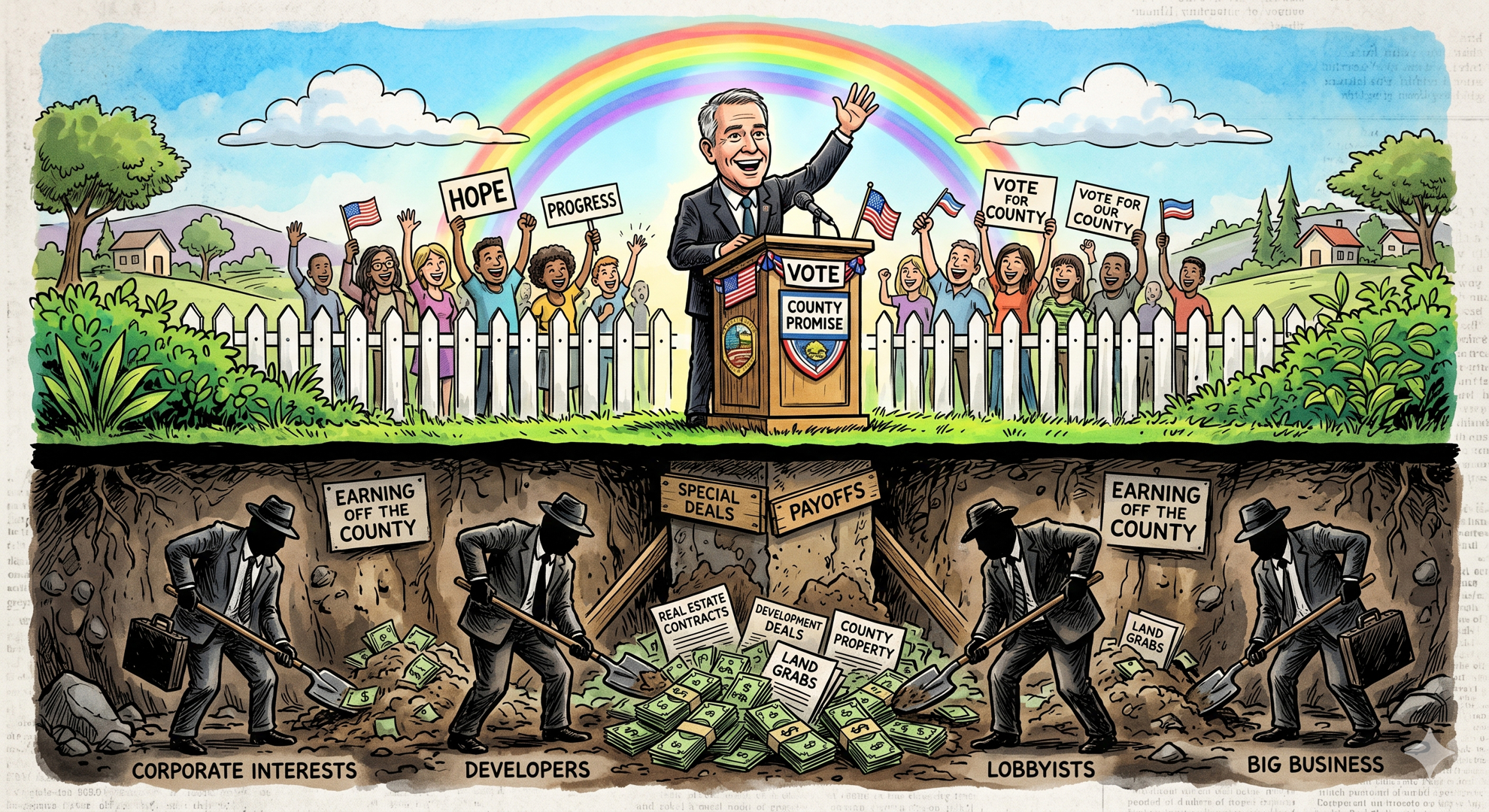
Nick Stewart wants voters to think he’s a wholesome family man and a progressive outsider running to clean up Towson. He capitalized on the pension grab pulled by Izzy Patoka and Julian Jones to position himself as the ethical choice for Baltimore County Executive. The marketing literature drops paint a picture of grassroots reform. The latest raw campaign finance data from January tells a completely different story. Stewart’s official “Stewart, Nick Citizens for” financial disclosure report reveals a massive cash stockpile bankrolled by a network of corporate lawyers, venture capital syndicates and real-estate developers.
The mainstream news desks–specifically the Baltimore Banner, the Baltimore Sun and WBAL Radio–completely failed the public by skipping basic due diligence on Nick’s 2026 campaign file. The entire Towson press corps chose to run soft campaign stenography instead of executing a real data audit. That’s not how The Baltimore Informer operates. They print his polished quotes about housing reform without checking his state financial disclosure files to see which real-estate cartels are funding his run. This lazy reporting allows a corporate-backed attorney to masquerade as a neighborhood savior while private equity syndicates build a multi-thousand-dollar fortress around his primary bid.
The charade ends today, here are the receipts:
Stewart accumulated a total of $400,739.41 in campaign receipts–leaving him with an ending cash balance of $239,530.22 at the start of the election year. You don’t collect a quarter-million dollars by holding neighborhood bake sales. This money represents a coordinated institutional buy-in. His own employer–the corporate law firm Duane Morris LLP–uses his campaign account like a corporate parking spot. The Duane Morris Government PAC dropped a legal maximum $6,000 check into his ledger. Individual corporate attorneys from the firm flooded his campaign with high-dollar contributions to secure direct access to the County’s executive office.
The financial ledger exposes a massive bundled cash operation tied directly to out-of-state venture capital interests. Wealthy executives from Ecphora Capital poured thousands into his war chest on the exact same day. Deborah Hemingway dropped $6,000. Frank Hemingway contributed another $6,000. The corporate entity itself matched those with a separate $6,000 check. Four other family members–Alexandria, William, Lilian and Carlisle Hemingway–each dropped $1,500. They executed a targeted capital injection from wealthy elites who intend to earn money off Baltimore County land-use policies. Ecphora Capital is a Baltimore-based medical-technology venture capital firm that oversees tens of millions of dollars in investment funds.
Out-of-state financial managers flood this local primary with cash to influence local policy. Stewart took $6,000 from JPMorgan Chase manager Robert Dorfman in New York. He pulled another $6,000 from tech executive Zachary Gidwitz in New York. He pocketed $5,000 from Connecticut executive Josh Smith.
Stewart doesn’t just drain his own firm’s political action committee. He pulls highly coordinated capital from competitor law firms like Saul Ewing LLP and Venable LLP. Saul Ewing acts as the supreme architect for Maryland Real Estate Investment Trusts. Venable specializes in structuring aggressive roll-up funds that swallow commercial properties. These competing firms fund him because his centralized HousingStat policy removes local zoning hurdles for their corporate clients.
The massive cash injections from mega-developers like Merritt Properties and Stonewall Capital expose the endgame. Merritt handles massive industrial expansion and recently secured a $400 million private equity injection. Stonewall Capital executes high-risk speculative land development and utilizes heavy government lobbying in Towson. Southern Management Companies dropped $1,000 as well. SMC operates massive multi-family housing complexes across the Mid-Atlantic. These developers need a fast-track permitting process to earn money. They back Stewart because he promises to dismantle the neighborhood associations standing in their way.
GreenVest LLC represents the most cynical play on the board. They don’t build houses. They manufacture environmental mitigation credits. When developers pave over Baltimore County green space, the law forces them to buy ecological offsets. GreenVest sells those exact regulatory permission slips. They fund Stewart to ensure the county keeps approving the destructive commercial developments that drive their entire profit model.
Elite institutional risk analysts are financing this local county executive race. Brian Bailey dropped over $4,700 in in-kind campaign hardware like software and teleprompters. Bailey previously served as a senior commercial real estate advisor for the Federal Reserve Bank of Atlanta. Wall Street is actively monitoring Towson’s zoning authority.
Heavy industry and real-estate developers bankroll this campaign for a specific reason. Kirby Development LLC handed over $6,000. Ecology Services Inc cut another $6,000 check alongside a personal $6,000 max contribution from its owner, Peter Osborne. These firms expect a massive return on their investment, no doubt about it. Nick Stewart’s “One County Initiative” serves as a corporate blueprint to fast-track commercial permits and streamline development. He plans to dismantle councilmanic courtesy to eliminate neighborhood resistance. His proposed “HousingStat” policy shifts zoning control away from local communities and hands it to unelected bureaucrats.
Let me state that again. Under Nick Stewart’s “One County Initiative” he packages HousingStat as a brilliant tool for transparency and accountability, but that’s just polished political marketing. His website explicitly states he wants to overturn local housing bans, fast-track mixed-use projects and establish density bonuses using massive tax abatements like TIFs. When he centralizes all that data and approval power into HousingStat, he yanks the steering wheel away from local neighborhoods. Instead of community groups pressuring their specific council member to block a massive corporate build, the developers bypass the council entirely.
Right now, there’s a big fight over land use rights in Fort Howard. HousingStat would directly affect that fight! When Stewart brags about his extensive public service record, he deliberately leaves out the fact that he completely bypassed the ballot box to get there. He has never been elected to office. He’s a corporate insider who played the elite appointment game. In case Citizens for Nick Stewart try to modify his plan, it’s archived here on the Internet Archive’s Wayback Machine.
Stewart is deeply tied to former Baltimore County Executive Jim Smith, who controlled the county from 2002 to 2010. Smith formally endorsed Stewart at a highly publicized press conference in Essex, where he aggressively slammed Stewart’s council opponents–Julian Jones, Izzy Patoka and Pat Young–as career legislators who lack any executive capability. Stewart treats Smith like a blueprint for his administration, explicitly stating in his policy platform that he plans to “reinvigorate the plans created by County Executive Jim Smith under his Renaissance initiative” for regions like Randallstown, Essex, Dundalk and Towson. Smith is actively using his political network to legitimize Stewart as the establishment heir.
The wholesome reformer narrative functions as a calculated smokescreen. Nick Stewart operates as a highly sophisticated corporate attorney running a campaign funded by the exact financial forces that want to pave over Baltimore County. Don’t fall for the deception, Baltimore! The County doesn’t need new developments, it needs the existing ones to be better maintained. It will be very interesting to see what the next Campaign Finance Form reveals, since this is old news from January but it was not reported on other media outlets (yet).


