Exelon’s Monopoly Over Marylanders’ Lives Must End
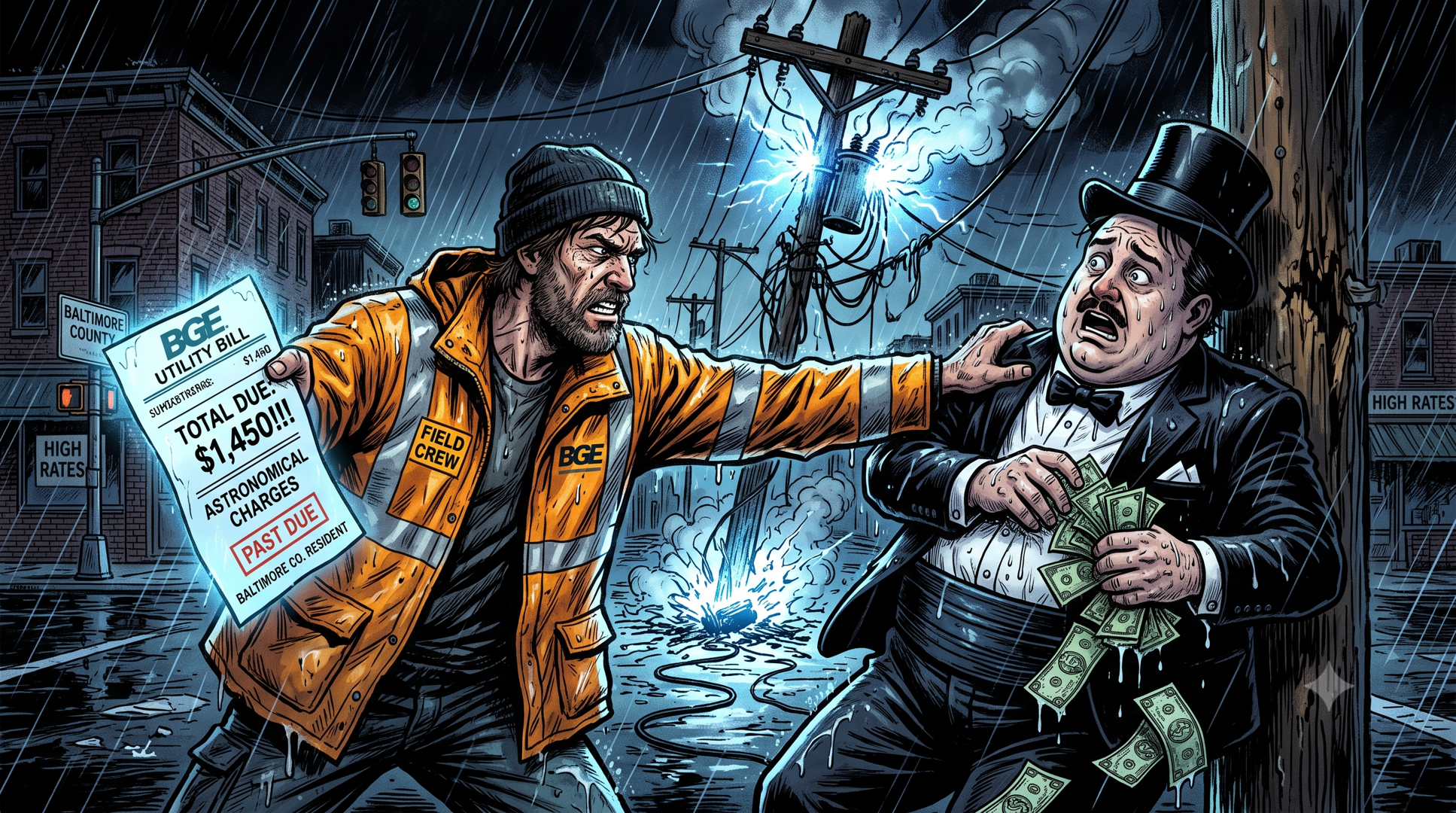
The Maryland Public Service Commission needs to reject Case No. 9888 today. Exelon — the Wall Street giant running BGE — wants another $156 million electric rate hike out of Baltimore County working families. They want state regulators to guarantee them a 10.4% “return on equity”. That means every home across Baltimore County gets stuck paying higher monthly distribution fees while local infrastructure rots and families argue at the dinner table over expensive bills.
Corporate executives hide behind complicated accounting terms during rate hearings at William Donald Schaefer Tower. Let’s look at the simple math. Gross profit means total money collected before paying business bills. Net profit means the pure cash left over after paying every single lineman salary, repairing storm damage across Catonsville, covering corporate taxes and funding operations. In 2025 alone, Exelon pocketed $2.77 billion in pure net profit.
That $2.77 billion net profit haul in 2025 was no accident. Since Exelon took over BGE back in 2012, the corporation stacked up over $30 billion in total net profits. They pulled $2.18 billion in 2022, $2.33 billion in 2023 and $2.46 billion in 2024. While their net profits kept climbing, Baltimore County gas delivery rates more than tripled to 97 cents per therm and electric delivery rates nearly doubled!
What many people may not know (because they don’t teach this stuff in government schools) is that corporate boards run under a strict legal trap known as shareholder primacy. The landmark ruling in Dodge v. Ford Motor Company established that corporations exist primarily to earn money for its stockholders. Delaware corporate law enforces this exact mandate today. Corporate directors owe a strict fiduciary duty to maximize Wall Street profits above every other human concern. If Exelon executives tried to lower electric rates to help struggling working-class families across Baltimore County, institutional shareholders could sue them for breach of duty. The legal system forces them to squeeze local ratepayers to satisfy out-of-state hedge funds.
Back in 1935, President Franklin D. Roosevelt signed the Public Utility Holding Company Act to smash corporate energy trusts. FDR saw big holding companies squeezing everyday citizens. Back when my grandparents were still children, federal law capped utility empires and protected local communities. Congress decided to tear up those statutory guardrails in the Energy Policy Act of 2005. That repeal opened the floodgates for Exelon to swallow BGE and turn state-regulated power into a cash engine for Wall Street right here in Baltimore County.
State power laws wrap a tight legal leash around every neighborhood in Baltimore County. If a local resident won a $500-million Mega Millions lumpsum jackpot tomorrow, they still couldn’t set up a private power setup to serve their own block. Under the Maryland Public Utilities Article, distributing cheap power to your neighbors remains an illegal act. The state outlaws competition whether you run copper cable down an alley or beam theoretical wireless power across a property line.
Imagine if Annapolis pulled this same legal scam with cell phones. Imagine if state lawmakers outlawed Verizon or T-Mobile from erecting cell towers across Baltimore County and forced every family onto one monopoly protected network. Federal lawmakers smashed that exact corporate racket when Congress passed the Telecommunications Act of 1996. That federal law forced AT&T to share its lines, unleashed market competition and drove mobile prices down. If you were around in the 1990s, you may recall the “dial around” long distance numbers 10-10-321 (which still exists) and 10-10-220. That Telecommunications Act is the reason why.
Maryland politicians keep doing the exact opposite with energy, trapping local families in a state-sanctioned telecom-style monopoly that outlaws real choice. It’s well past time to repeal the portion of the Maryland Public Utilities Article that allows Exelon to grab Marylanders by the balls every single billing cycle.
The Maryland Office of People’s Counsel already exposed Exelon’s strategy for relying on continuous rate hikes to satisfy Wall Street investors. Exelon uses a state-sanctioned monopoly to earn money without facing real market competition. They routinely hand roughly 60% of their net profits straight to institutional shareholders in cash dividends. Baltimore County taxpayers are getting these wooden utility poles shoved down our throats so out-of-state hedge funds can collect guaranteed risk-free paydays.
Send this article to every State Senator and State Delegate plus the candidates running for those offices. Ask them point blank if they will pledge under penalty of perjury/removal from office to repeal Maryland Code: Public Utilities Article (Division I, PU § 1-101 et seq.). Specifically the portion that gives Exelon their monopoly.