

Maryland’s Dynamic Retail Pricing Law is a Lie
By: Adam Reuter
This article is a big one! So here is the TL;DR (too long, didn’t read) summary:
Working families across Maryland expect grocery price relief on October 1st. Governor Wes Moore signed House Bill 895 on April 28, 2026. State politicians hyped the Protection From Predatory Pricing Act as a total ban on algorithmic grocery gouging. It was the crown jewel piece of legislation this past year. Social media commenters celebrate the law and journalists bought the statehouse spin hook, line and sinker. The actual statute contains massive corporate carveouts that leave everyday grocery carts completely naked to automated price hikes.
The 24-Hour Price Freeze Got Killed: Governor Wes Moore promised grocery prices would stay locked for at least one full business day under House Bill 895. Corporate retail lobbyists gutted that mandate behind closed doors before the April 28 bill signing.
Same-Day Surge Pricing Remains Fully Legal: Supermarkets across Baltimore County can legally hike shelf tags multiple times an afternoon using electronic shelf displays. Chapter 154 only outlaws individualized surveillance pricing–meaning grocers hold statutory immunity to spike prices on every shopper in the aisle simultaneously.
The Loyalty App Trap: Section 13-321(A)(3)(II)(7) exempts data-driven pricing if a customer consents. Every shopper tapping “agree” on a grocery store rewards app surrenders their legal protection at the door.
Consumers Cannot Sue: Annapolis politicians slipped Section 13-321(E) into the statute to ban private civil lawsuits. Disgruntled consumers must beg the state Attorney General for help, and the state must grant violating corporations a mandatory 45-day grace period to fix the scam before levying a single dime in fines.
Local Television News Blew The Story: Regional stations like WJZ, WBOC and WUSA9 failed to read the final enrolled bill. They broadcast demonstrably false reports claiming grocery prices must stay fixed for 24 hours–parroting administration press releases while consumers get set up for a checkout surprise on October 1st.
Summary over, onto the article…
Big retail giants like Walmart operate massive supercenters across Baltimore County from Golden Ring to Catonsville and throughout Maryland. Under the final text of Chapter 154, these chain stores hold the legal green light to alter prices five times before lunch. Governor Moore stood behind a podium in January (archive link) and promised a strict one-day price lock. Corporate lobbyists ripped that 24-hour guarantee out of the draft behind closed doors.
Maryland Retailers Alliance president Cailey Locklair cut the bill’s teeth out during closed-door committee sessions in Annapolis. Locklair bragged to retail trade outlets that the industry readily endorsed the amended statute because grocery chains do not even deploy individualized biometric pricing. Corporate lobbyists secured statutory immunity for chain stores to hike store-wide prices throughout the day (industry/technical word: intraday) across Maryland. They traded a tool they never use for the legal right to squeeze consumers.
The revised statute only outlaws individualized surveillance pricing on tax-exempt food items. An algorithm cannot legally scan your private web cookies or facial expressions to tack twenty cents onto your milk. Stores can still spike the exact same shelf tag for every shopper in the aisle simultaneously. When rush-hour crowds flood grocery aisles along Eastern Boulevard or York Road, corporate servers can trigger digital shelf tags to hike costs instantly.
Independent watchdogs at Consumer Reports actually read the final text and publicly warned everyone about these massive corporate loopholes. Consumer Reports flagged the weak enforcement mechanisms before the ink even dried. Every major television news desk covering Annapolis completely ignored them.
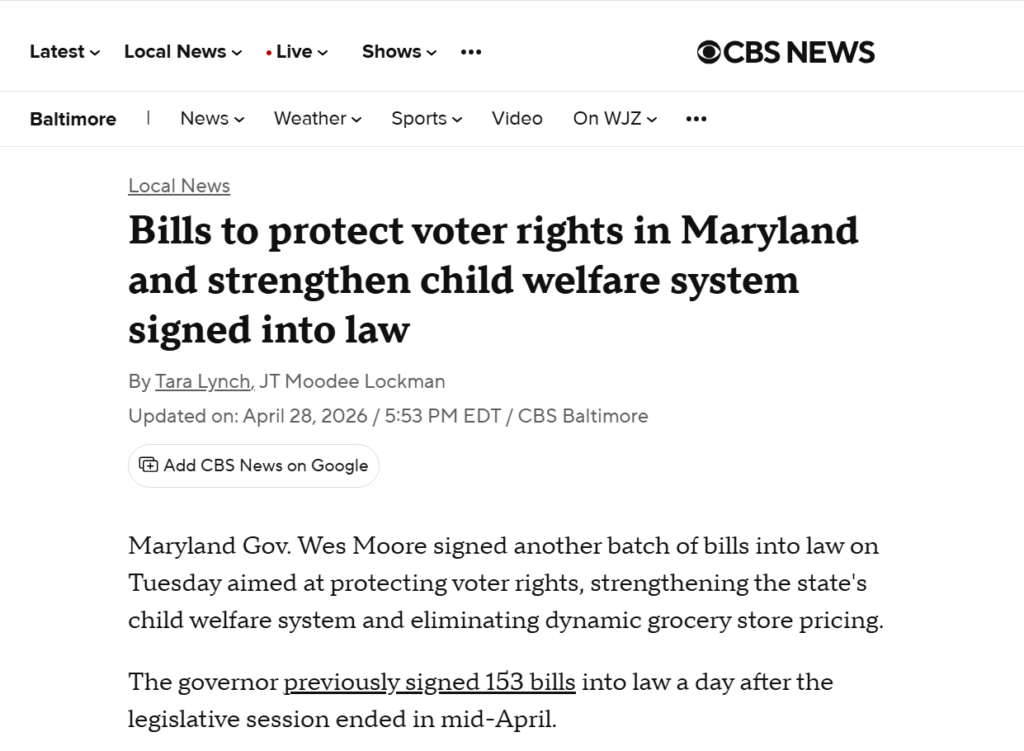
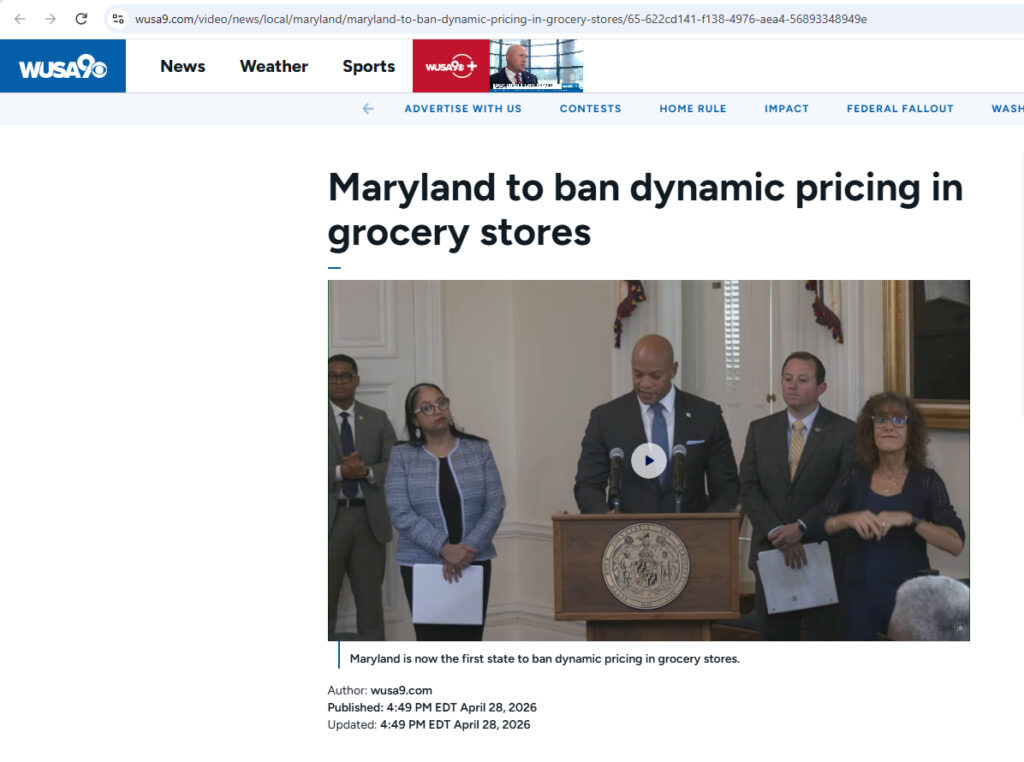
Local news desks across the region committed pure journalistic malpractice by refusing to read the final enrolled bill. WJZ reporter Tara Lynch and Jeanne Tyler “JT” Moodee Lockman told television viewers on April 28 that the new law forces grocery stores to keep prices fixed for at least one business day.
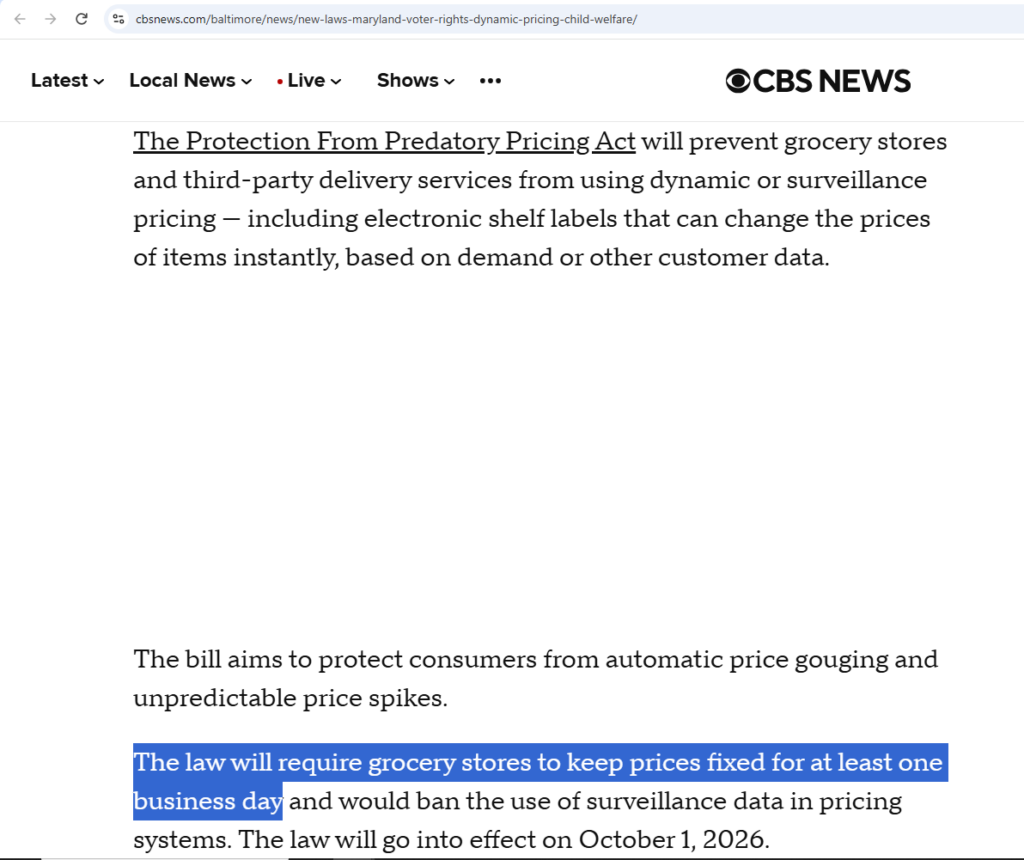
Over on the Eastern Shore, WBOC reporter Anthony Evangelista broadcast the exact same false claim to Salisbury and Ocean City audiences.
Washington station WUSA9 swallowed the administration’s victory press release whole, airing glowing segments that hid every single corporate carveout from working taxpayers. These legacy broadcast producers operate as glorified press release readers–they lack the editorial grit to read a statutory amendment packet. Television journalists need to do their damn jobs, dig into the primary documents or hire independent reporters like yours truly who actually read the bills. Admittedly, I trusted the big guns to honestly report on this huge story back in April. That was a terrible assumption to make and I deeply regret the error in judgment.
While regional newsrooms fired their researchers, corporate lobbying shops upgraded to algorithmic warfare. Multi-billion-dollar retail trade groups don’t manually refresh the Maryland General Assembly website like regular taxpayers. They deploy high-end legislative intelligence engines like FiscalNote, Plural and USLege.
These platforms use artificial intelligence to scrape committee dockets, track legislative markups in real time and model the passage odds of every bill touching corporate revenue. Corporate lobbyists deployed advanced software to pinpoint the original 24-hour price freeze, draft surgical statutory carveouts and insert corporate immunity directly into Chapter 154 before Marylanders even knew a hearing was scheduled.
Labor organizers at United Food and Commercial Workers Local 27 represent over 18,000 grocery staff throughout our region. Union leadership explicitly warned state lawmakers that digital tags exist to slash retail jobs and inflate prices while shoppers walk the floor. Annapolis politicians killed the union’s amendments to ban electronic shelf labels outright. Automated electronic shelf tags remain fully protected in giant supercenters. Other testimony is interesting to take a retrospective gander through.
The final statute strips Baltimore County consumers of any direct legal muscle. Senate leadership inserted Section 13-321(E) to explicitly block private civil lawsuits against gouging retailers. Disgruntled shoppers must grovel to the Maryland Attorney General Consumer Protection Division. Section 13-321(D) guarantees corporate headquarters a mandatory 45-day grace period to correct a pricing scam before the state can levy a single dollar in fines.
Corporate retail lobbyists rewrote Annapolis legislation to protect corporate bottom lines while lawmakers pretend to save your grocery cart. Working people across Baltimore County bust their backs every week to earn money. October 1st brings an algorithmic shell game. The politicians who voted for this sham sold out their constituents for corporate campaign checks.
LEGISLATIVE DOSSIER: MARYLAND HOUSE BILL 895 (2026 REGULAR SESSION)
Official Act: Chapter 154, 2026 Laws of Maryland (Cross-filed as Senate Bill 387)
Primary Sponsor: The Speaker (By Request–Administration)
Signed into Law: April 28, 2026
Effective Date: October 1, 2026
THE GUTTING OF DYNAMIC PRICING AND THE 24-HOUR PRICE FREEZE
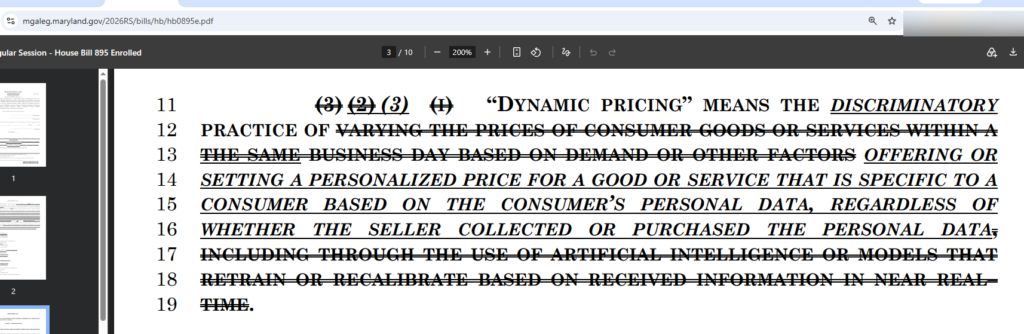
Original Bill Text (House Bill 895 First Reader, Page 2, Section 13-321(A)(3)(I), lines 20-22): “Dynamic pricing” means the practice of varying the prices of consumer goods or services within a business day based on demand or other factors, including through the use of artificial intelligence or models that retrain or recalibrate based on received information in near real-time.
Final Enrolled Law (House Bill 895 Enrolled, Pages 2-3, Section 13-321(A)(3)(I), lines 12-19): “Dynamic pricing” means the discriminatory practice of offering or setting a personalized price for a good or service that is specific to a consumer based on the consumer’s personal data, regardless of whether the seller collected or purchased the personal data, including through the use of artificial intelligence or models that retrain or recalibrate based on received information in near real-time.
Legislative Change: Through Senate Finance Committee Amendment 373020/01 and floor amendments, lawmakers struck out the phrase “varying the prices of consumer goods or services within a business day based on demand or other factors”. They replaced it with language limiting the definition exclusively to personalized pricing based on personal data. This amendment killed the promised one-business-day price freeze. Retail chains hold full authority to alter store-wide shelf prices multiple times per day using electronic shelf labels.
STATUTORY CARVEOUTS PERMITTING SAME-DAY AND SURGE PRICING
Original Draft: Did not contain blanket exemptions for local demand fluctuations or supply-chain cost shifts.
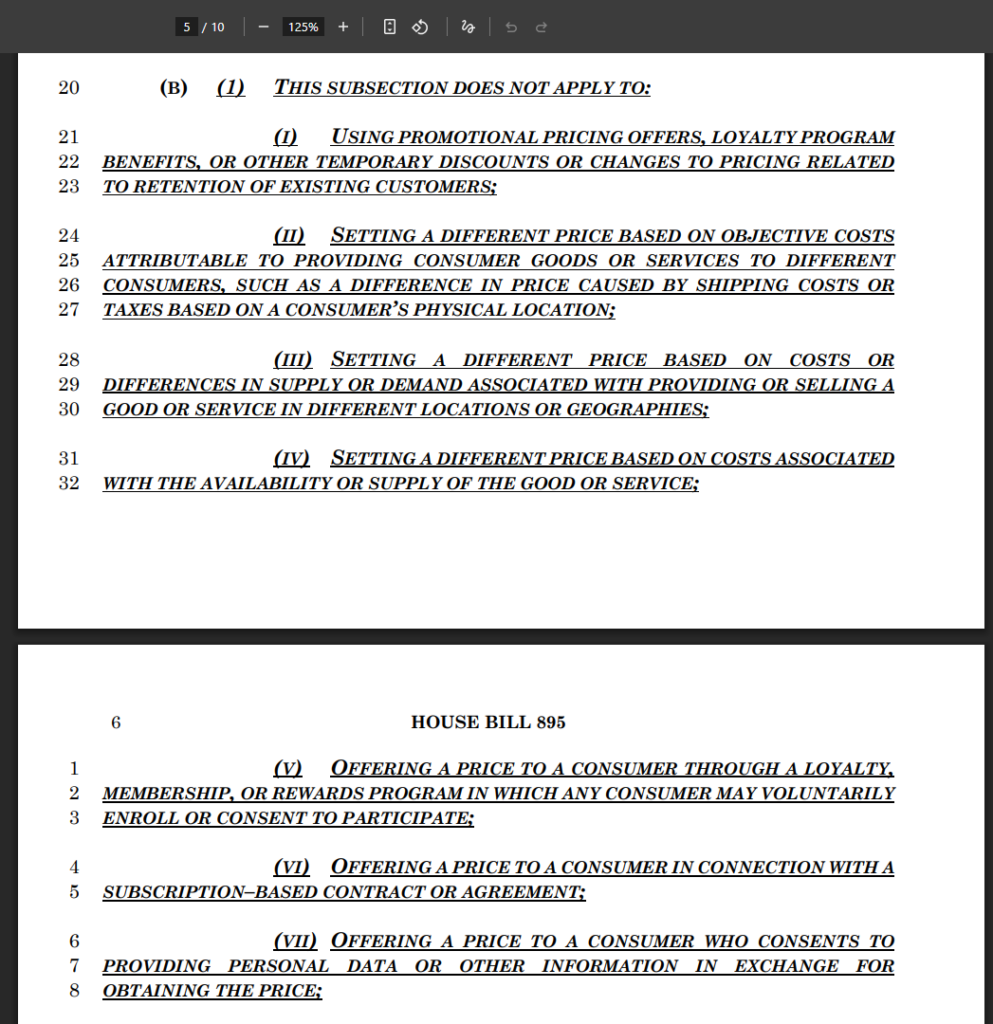
Final Enrolled Law (House Bill 895 Enrolled, Pages 5-6, Section 13-321(B)(1), lines 20-32 and lines 1-8): The final statute explicitly carves out the following practices from enforcement:
- Subsection (B)(1)(III): Setting a different price based on costs or differences in supply or demand associated with providing or selling a good or service in different locations or geographies.
- Subsection (B)(1)(IV): Setting a different price based on costs associated with the availability or supply of the good or service.
- Subsection (B)(1)(VII): Offering a price to a consumer who consents to providing personal data or other information in exchange for obtaining the price.
Legislative Change: Subsections (III) and (IV) explicitly grant stores statutory immunity to raise prices throughout the day based on wholesale spikes, delivery snags or supply-and-demand changes. Subsection (VII) hands retailers a wide-open expressway to run data-driven algorithmic pricing if shoppers agree to loyalty-app terms.
Let’s be clear: Subsection (VII) guts the last microscopic defense the bill pretended to build for Maryland consumers.
State politicians bragged that they banned surveillance pricing, then quietly inserted Section 13-321(B)(1)(VII) to exempt any price offered to a consumer who consents to handing over personal data. Every major grocery chain in Maryland already corners shoppers into using digital loyalty apps and store cards to access basic shelf discounts. When you download a supermarket app, register a phone number or tap “agree” on a digital terms-of-service screen just to get a discount on milk, you surrender your legal protection under Maryland statutory law.
Annapolis lawmakers legalized the primary pipeline corporate retail uses to conduct data profiling. You can’t make this stuff up!
DESTRUCTION OF CONSUMER LAWSUITS AND INSERTION OF CURE PERIODS
Original Draft: Allowed private civil remedies under Maryland Commercial Law Section 13-408, enabling citizens to sue bad actors directly for actual damages and legal fees.
Final Enrolled Law (House Bill 895 Enrolled, Page 5, Section 13-321(E), lines 1-2): “This section may not be construed to authorize a private right of action under this section or any other law.”
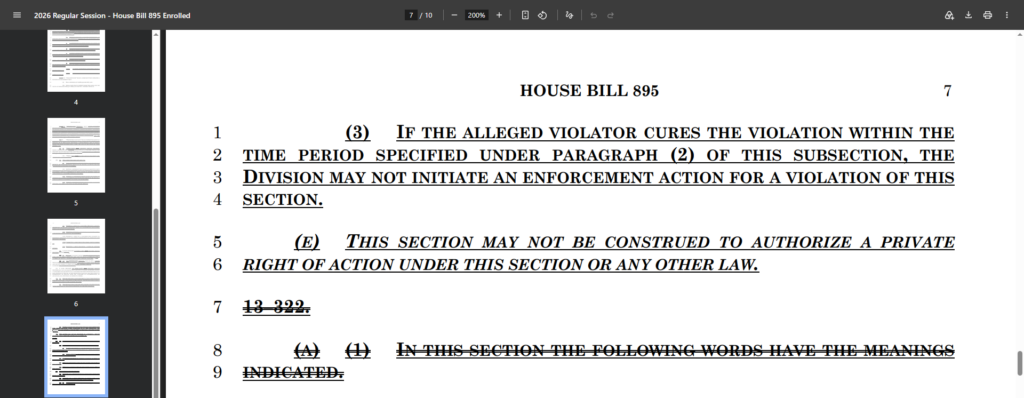
Enforcement powers sit solely with the Maryland Attorney General Consumer Protection Division. Section 13-321(D) forces the Attorney General to send a formal violation notice and provide a mandatory 45-day cure window. Corporations hold forty-five days to remedy unlawful practices before facing administrative prosecution or statutory fines.
State leaders sold House Bill 895 as the crown jewel achievement of the 2026 Annapolis legislative session. Thousands of Marylanders–myself included–bought the pitch and proudly championed this law to family and friends living in other states, believing Maryland genuinely drew a line in the sand against corporate grocery gouging. We got hoodwinked!
The rot spread far beyond local television broadcasts. Across YouTube and digital media, commentators and legal channels blasted the statehouse press release to hundreds of thousands of viewers without bothering to open the enrolled bill text. Attorney Steve Lehto assured his massive audience that Maryland stores must freeze prices for a full business day. Regional outlet DC News Now told viewers that the law outlawed prices shifting by time of day or customer demand.
Digital channels like Consumer Law Hub and Laws & Loopholes repeated the exact same phantom 24-hour price freeze. Everyday creators like Deep River Farm celebrated the measure on camera, genuinely believing state leaders stepped up to shield working families from grocery gouging.
Only national reporting from PBS NewsHour cut through the noise. Consumer Reports policy analyst Grace Gedye told PBS on national television that lawmakers stripped the core dynamic pricing ban completely out of the bill. That lone voice of journalistic scrutiny got buried under an avalanche of unverified hype. This collective failure constitutes an absolute tragedy. Working families will walk into supermarkets on October 1st and beyond, assuming the State government protects their wallet. Instead, they face an unregulated checkout trap because the public watchdogs surrendered their skepticism.
For everyday shoppers, the law’s most devastating effect is insulating grocery conglomerates from consumer lawsuits while gutting real regulatory accountability.
Television newsrooms, hollowed out by corporate staffing cuts and blinded by pure carelessness, swallowed administration talking points whole and broadcast false promises across the public airwaves. They left working families across Maryland completely exposed to same-day price gouging while singing victory hymns for politicians. October 1st arrives in two weeks and the corporate shell game begins. It’s time for local media to stop repeating lobbyist spin and set the damn record straight. Correcting the official record strips away the corporate smoke screen–giving taxpayers the raw, unvarnished truth they need to demand real legislative accountability.


