Was The Baltimore Banner’s Coverage of Tim Fazenbaker Fair? Baltimore County District 9 Race

By: Adam Reuter
INFORMER SUMMARY:
- The Omitted Legal Histories: While The Banner combed six years of court dockets for Fazenbaker’s dismissed peace orders, it overlooked Wade’s prior legal names (Jamaludeen and Gowins). On her sworn 2026 State Board of Elections filing (Filer ID: 16018355), Wade explicitly designated
arkiagowins@gmail.comas her official campaign contact email.
- The Career Pivot: The profile framed Wade as a grassroots civic caregiver while omitting her 23-year career as a corporate healthcare professional at CVS Health/Aetna, which concluded in June 2023. She holds zero clinical medical, nursing or licensed clinical social work credentials in Maryland or Virginia.
- The “Crossover” Sleight of Hand: The article highlighted a $1,000 donation from Ed Hale Sr. as evidence of traditional conservatives defecting, omitting that Hale was a registered Democrat for decades before switching to the GOP in August 2025.
- The 39-Day Clean-Money Pivot & 501(c)(3) Commingling: After entering the race under Baltimore County’s small-donor “Fair Election Fund” in December 2025, Wade withdrew just 39 days later to pursue traditional high-dollar political action committee (PAC) fundraising. Digital audit trails show the state withdrawal document was created directly via
director@ncompanion.org—her executive email at her tax-exempt 501(c)(3) non-profit.
- The Baltimore Banner and reporter Sapna Bansil were contacted for comment regarding the findings in this report; this article will be updated with any response.
When local newsrooms cover competitive local elections, their primary civic obligation is clear: hold every candidate to an identical standard of scrutiny so that voters can evaluate them on equal terms. In an era where regional newspapers have consolidated or vanished, digital “non-profit” metropolitan outlets like The Baltimore Banner carry tremendous influence in shaping public perception. That influence was on full display in the Banner’s October 28 profile of the race for Baltimore County Council District 9, headlined: “As a MAGA candidate divides his party, can Democrats turn Dundalk blue?”
The contest between Republican nominee Tim Fazenbaker, Democratic nominee Arkia Wade, and independent tavern owner Donna Eve Radtke Sekora is pivotal. With the County Council expanding from seven to nine seats, District 9 represents the decisive battleground determining whether Democrats secure a legislative supermajority.
Yet an objective audit of the Banner’s coverage reveals distinct editorial asymmetries. By analyzing the piece through established journalistic principles—parity of public records vetting, proportional campaign finance disclosure, and visual framing—the reporting demonstrates a persistent thumb on the scale. Rather than examining the complex realities of county administration, the article relied on a nationalized culture-war template: the combative outsider versus the gentle civic healer.
Author’s Note & Disclosure:
The author of this analysis, Adam Reuter, previously served as a volunteer on Tim Fazenbaker’s campaigns and produced paid video content for his candidacy. In the interest of total transparency and journalistic integrity, this article is published not as campaign advocacy, but as an evidence-based media critique.
Every empirical claim, statutory limit, judicial docket and campaign finance ledger cited herein was audited and cross-verified against primary government records–including the Maryland Campaign Reporting Information System (MDCRIS), Maryland Judiciary Case Search, and SDAT property databases–utilizing rigorous, AI-assisted investigative fact-checking protocols. Readers are encouraged to independently examine the primary source documentation linked at the conclusion of this report.
The Architecture of the Frame: Visual Disparities and Photo Volume
Fair journalism begins with neutral framing. A candidate’s personal style and public statements are fair game, but when editorial choices systematically magnify one candidate’s perceived hostility while sanitizing their opponent’s record, coverage slips into advocacy. In digital journalism, visual presentation often communicates more to casual readers than thousands of words of text.
The Quantitative Imbalance in Photo Selection:
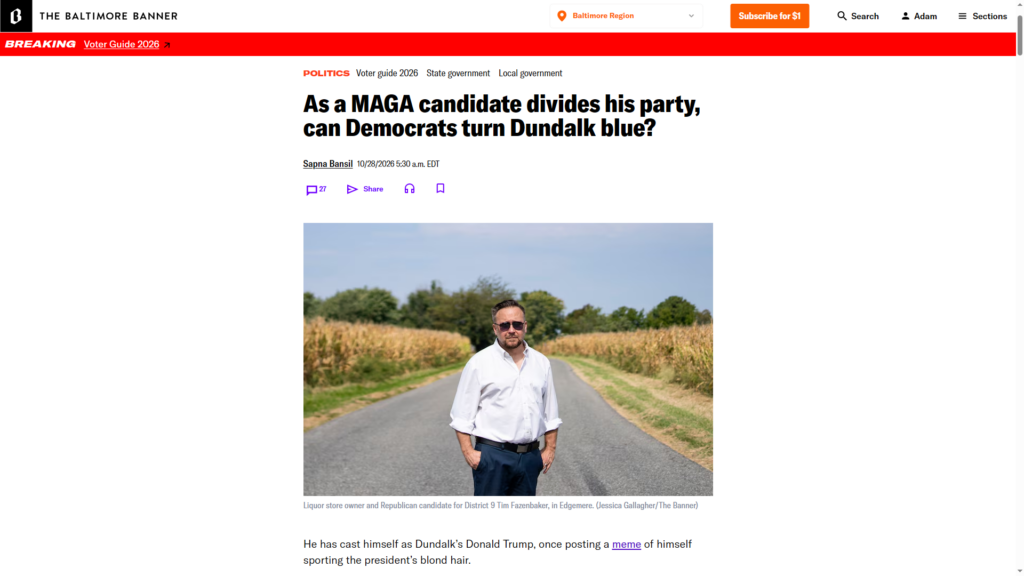
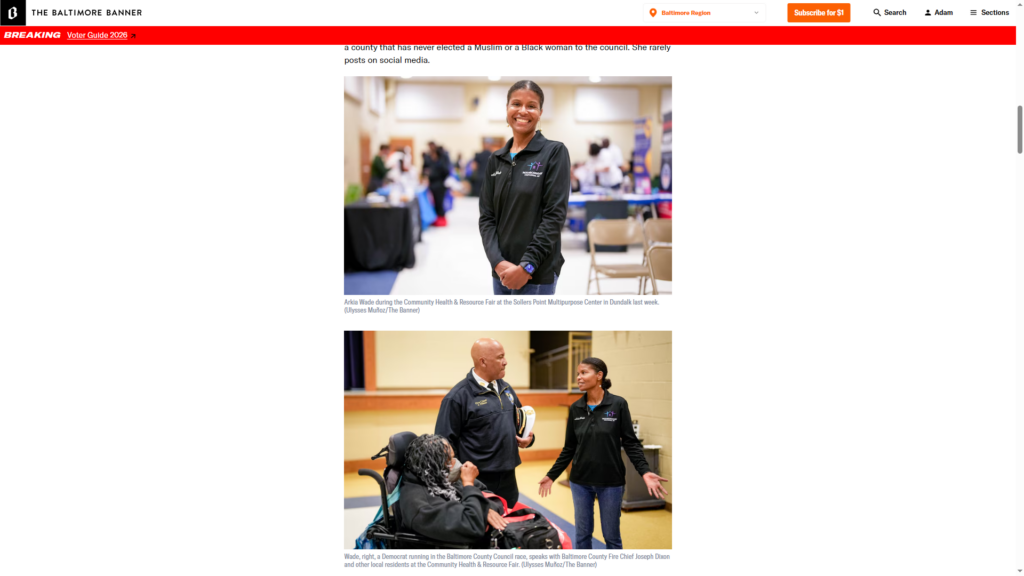
The visual balance between the campaigns was immediately skewed by volume. The Banner ran three distinct, high-resolution photographs showcasing Wade across various community settings–capturing her in diverse, warm environments alongside neighbors, supporters, and local figures. In contrast, Fazenbaker was restricted to a single, stark photograph. In visual pacing, awarding multiple varied community shots to one candidate while reducing the other to an isolated snapshot immediately signals to the reader who belongs in the community and who stands apart from it.
The Qualitative Contrast in Lighting and Composition:
Beyond the raw photo count, the composition of the imagery established character judgments before readers reached the lead paragraph:
- The Fazenbaker Staging: Fazenbaker was photographed standing completely alone on an open road in Edgemere, framed against an empty horizon under harsh, unflattering midday glare. Clad in dark sunglasses and positioned in a rigid, solitary stance, the composition visually coded him as an unapproachable, confrontational outlier.
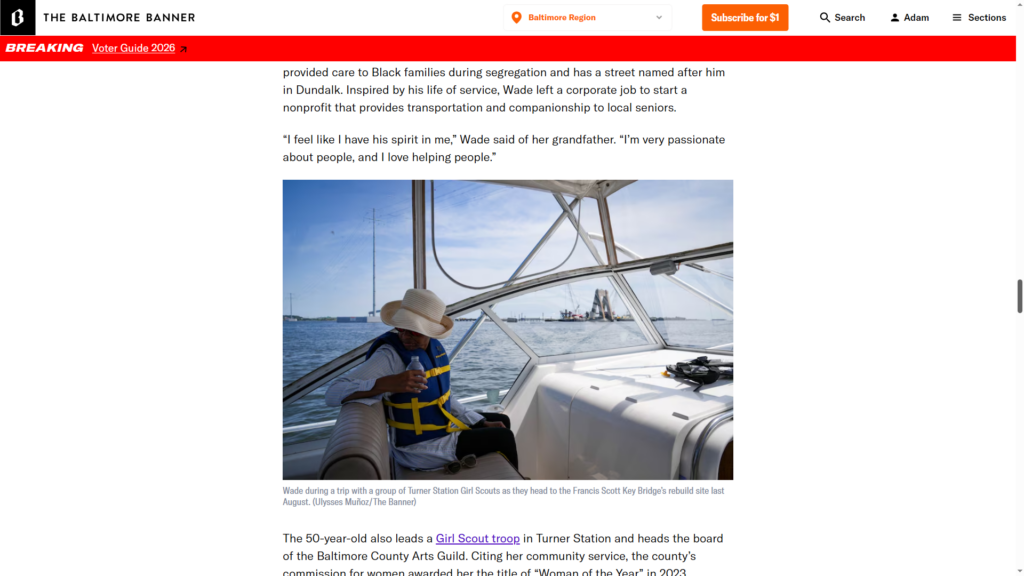
- The Wade Staging: Wade is depicted in warm, balanced indoor lighting, smiling and seamlessly integrated among engaged constituents. She is also positioned against the backdrop of the Francis Scott Key Bridge site–ground zero for District 9’s defining economic and infrastructure recovery effort. The composition systematically telegraphs accessibility, civic empathy, and proactive community stewardship.
In political photojournalism, this visual contrast reinforces an explicit narrative: the isolated agitator pacing an empty road versus the collaborative public servant working inside the neighborhood.
Present-Tense Stereotyping vs. Sanitized History
The editorial bias extends directly into the article’s captioning. The lead photograph introduces Fazenbaker as a “Liquor store owner and Republican candidate”–a claim that is factually false in the present tense. As reported by The Dundalk Eagle in September 2025, Fazenbaker shuttered Faze 4 Liquors years ago.
While the Banner slapped an outdated, vice-adjacent retail label on Fazenbaker in the active present tense, it applied the opposite standard to Wade: her 23-year corporate career at health insurance giant CVS/Aetna was reduced to a passing mention of leaving “a corporate job”, allowing her cutlines to frame her solely as a non-profit director and Girl Scout leader.
The Narrative Hook vs. The Finance Ledger: The Leadership Slate
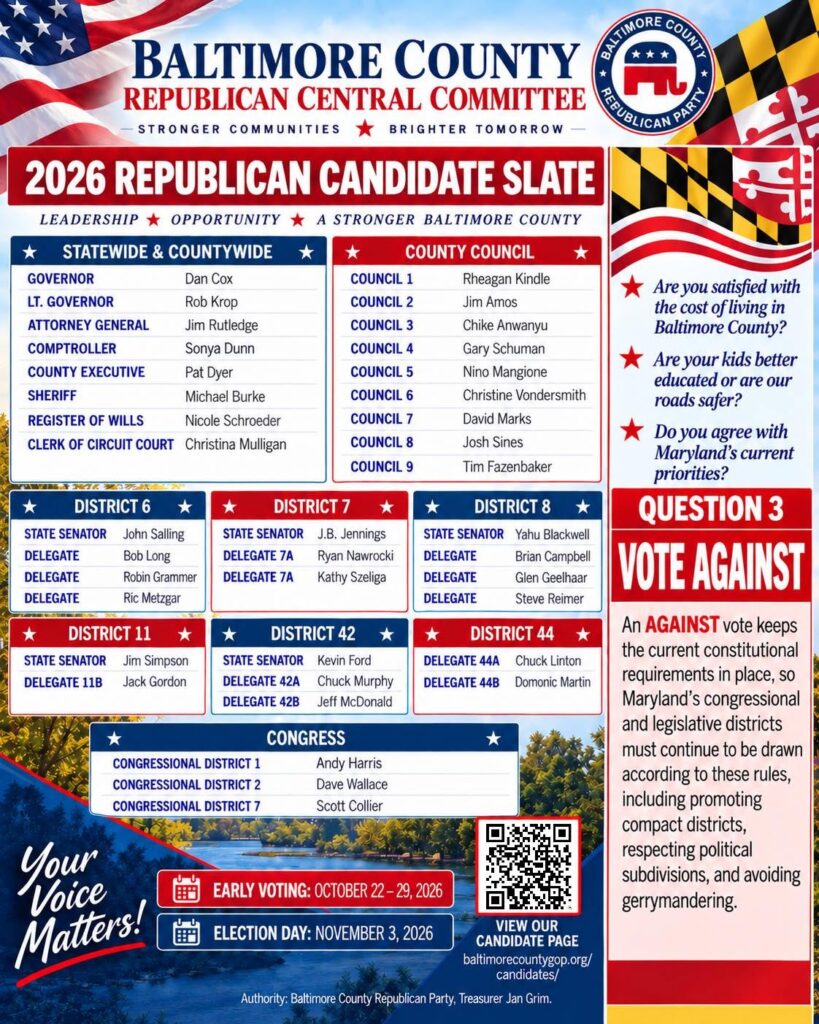
Narratively, the article led with the Baltimore County Republican Central Committee’s 24–0 vote to censure Fazenbaker during the primary season. While the censure was a legitimate news event, the article treated this non-binding party vote as proof of total political exile, ignoring how general election machinery come together when institutional power is on the line.
To be clear, The Baltimore County Central Committee now officially supports Tim Fazenbaker’s bid for the County Council seat:
To reinforce this narrative, the Banner spotlighted a September fundraiser for Wade at the Millers Island home of former Republican gubernatorial candidate Ed Hale Sr., specifically highlighting Hale’s $1,000 personal contribution as evidence of traditional conservatives breaking ranks.
What the Banner failed to disclose is that Hale was a freshly minted Republican. Public voter registration and news archives confirm Hale had been a registered Democrat for decades before switching his affiliation to Republican in August 2025 to launch a 2026 gubernatorial primary campaign. Framing a donor who spent nearly his entire adult and business life inside the Democratic Party–and whose Republican registration was barely 14 months old–as an example of lifelong conservatives “crossing party lines” to reject Fazenbaker represents an editorial sleight of hand designed to fit a pre-determined narrative rather than historical reality.
The Operational Realities of Campaign Spending: Basic Overhead vs. Selective Framing
To evaluate campaign finance objectively, voters need to understand standard campaign operations: running a competitive municipal campaign across an entire council district is an expensive operational undertaking. In an expanded Baltimore County Council district comprising tens of thousands of registered voters, communicating a policy platform requires substantial funding.
A single full-color direct mail piece delivered to 15,000 targeted voter households costs roughly $8,000 to $12,000 once printing, addressing and bulk postage are factored in. Running targeted digital video and streaming commercials across platforms like YouTube and other video streaming services demands thousands more, not to mention the baseline costs of yard signs, walking literature and voter file databases. A $24,000 transfer does not fund personal luxury; it covers the basic cost of two mailings or a routine digital ad flight to let residents know who is on the ballot.
Both candidates faced these exact financial realities. Wade significantly outraised Fazenbaker, compiling a war chest funded by traditional Democratic donors, statewide political action committees and regional healthcare executives. Raising institutional capital, pooling slate resources, and spending heavily on voter outreach is standard operating procedure in Maryland politics, not an ethical transgression.
The journalistic failure of The Banner was not in reporting that money matters, but in applying an unfair double standard. By magnifying an isolated $1,000 crossover contribution from Ed Hale Sr. to validate a narrative of Republican abandonment, while omitting the routine slate transfers that funded Fazenbaker’s outreach within state statutory limits, the coverage swapped ordinary campaign mechanics for a curated storyline.
The Vetting Asymmetry: Judicial Dockets vs. Omitted Legal Histories
The most glaring departure from journalistic standards lies in the contrasting depths of background vetting applied to the two major-party nominees.
The Scrutiny Applied to Fazenbaker:
The Banner conducted an extensive review of the Maryland Judiciary Case Search database, reporting that at least eight individuals had filed civil peace order petitions against Fazenbaker over the past six years. The article detailed a petition filed by Republican Delegate Ric Metzgar. While the piece acknowledged in passing that most of the petitions were denied and that Fazenbaker had never been convicted of a crime, dedicating substantial ink to unadjudicated, dismissed civil disputes inevitably frames the subject as volatile.
The Absence of Scrutiny for Wade:
Standard investigative practice requires applying the exact same public-records search parameters to every candidate on the ballot. Yet the Banner presented Arkia Wade strictly under her paternal grandfather’s surname, leaning entirely on the civil rights and medical legacy of Dr. William C. Wade Sr. in Turner Station.
Public records demonstrate that the candidate’s public identity features a far more complex naming evolution:
- Historical Legal Names:
Born Arkia Jamaludeen in February 1976 in Hampton, Virginia–her father having converted to Islam and taken the name Abdul Hamid Jamaludeen–she spent the vast majority of her adult and professional life operating legally and commercially under the name Arkia Amira Gowins. - The 2021–2022 Rebranding Timeline:
The adoption of the Wade surname for public life is a very recent transition. As recently as November 18 and 23, 2021, the candidate testified under oath before the Baltimore County Board of Appeals regarding a local zoning dispute involving St. Rita’s Roman Catholic Congregation under the name Arkia Gowins (Case No: 21-105-SPHXA).
Less than three months later, on February 2, 2022, the Circuit Court for Baltimore County granted her civil petition to officially change her legal name to Arkia Amira Wade (Docket # C-03-FM-20-001334). Five months after that decree, in July 2022, she incorporated her non-profit, Neighborhood Companions, Inc., utilizing her newly established legal surname. - Active Fragmented Identities:
Her personal social media accounts remained registered under Arkia Jamaludeen (even while displaying an “Arkia Wade for Baltimore County Council” badge), while public campaign contact registries routed to an email address bearing the Gowins name.
Proving that the Gowins surname is not distant history, official records from the Maryland State Board of Elections reveal that on the sworn Statement of Organization approved on January 28, 2026–and amended as recently as August 25, 2026–for her active committee Wade, Arkia Elect (Filer ID: 16018355), Wade explicitly designatedarkiagowins@gmail.comas her official public campaign contact email. - Property and Code Records:
While framed in local coverage around generational homeownership roots in Dundalk, state assessment matrices from the Maryland Department of Assessments and Taxation (SDAT) reveal that the primary Dunleer Road residence is titled and assessed under Abdul Hamid Jamaludeen, rather than Arkia Wade directly. Consequently, municipal administrative notices—such as Baltimore County Code Enforcement hearing docketCC2501116—are directed to Jamaludeen as the property owner of record.
The significance for voters is not the citation itself, but the public records firewall: a newsroom searching public indexes solely under “Arkia Wade” effectively bypasses the legal dockets, property records and municipal files that govern the candidate’s actual household.
In plain terms, Arkia Wade does not hold legal title to the house she lives in and municipal code violations at that address are legally the responsibility of her father, not her.
Failing to report a candidate’s prior legal names creates an artificial public records firewall. If an outlet investigates dismissed civil petitions back six years for one candidate, journalistic parity dictates running comprehensive docket searches on the names legally utilized by their opponent during that exact same timeframe.
Affinity Bias: Corporate Health Insurance vs. The “Caregiver” Frame
Journalistic bias is rarely a conscious conspiracy; more often, it stems from affinity bias–the tendency to view people from one’s own professional background with inherent trust while viewing outsiders with skepticism.
The Baltimore Banner reporter, Sapna Bansil, worked for nearly a decade as a pediatric occupational therapist at the Kennedy Krieger Institute in Baltimore before graduating from the University of Maryland Merrill College of Journalism in May 2024. Allied health disciplines are grounded in patient advocacy, community care and social service delivery.
The Banner embraced Wade’s non-profit profile as pure, selfless volunteerism. However, open-source records and professional registries reveal a very different career trajectory:
- Wade is not a lifelong grassroots social worker; she spent 23 years as a corporate healthcare professional at CVS Health (Aetna), serving in corporate administrative and operational capacities (provider relations liasison) before resigning on the Juneteenth holiday in 2023 to transition into grant-funded non-profit administration.
- Professional licensing audits across Maryland and Virginia confirm that Wade holds no clinical medical, nursing, or licensed clinical social worker (LCSW) credentials, nor any assisted-living facility manager certifications. Her background is in corporate health insurance operations.
In Maryland, healthcare and social services represent a multi-billion-dollar economy fueled by taxes: Medicaid waivers, Medicare reimbursements and competitive county grants. The Baltimore County Council regularly votes on millions of dollars in supplemental appropriations for the Department of Aging, Community Development Block Grants (CDBG), and zoning exceptions for medical and care facilities.
By framing Wade’s background strictly as charitable virtue rather than a two-decade corporate insurance career transitioning into grant-funded non-profit administration, the Banner bypassed critical policy questions:
- How would a council member with active ties to elder-care non-profits navigate votes on Department of Aging contracts and grant appropriations?
- What policy commitments were made to the institutional healthcare network–including regional hospital administrators and clinicians–whose donations populated Wade’s finance reports?
Fazenbaker’s donors–rooted in industrial manufacturing, commercial contracting, and maritime trade at Tradepoint Atlantic–were treated through the cynical lens of political partisanship. Wade’s donors, heavily drawn from the taxpayer subsidized medical sector, were granted the moral high ground without scrutiny.
Editorial Scrutiny Comparison
| Evaluation Category | Coverage of Tim Fazenbaker | Coverage of Arkia Wade |
| Visual Presentation | Single photo; harsh midday lighting; isolated on an empty road in sunglasses. | Multiple photos; warm indoor lighting; surrounded by smiling constituents. |
| Headline & Framing | Framed as an aggressive “MAGA candidate” dividing his own party. | Positioned as a “striking contrast” and calm civic alternative. |
| Public Identity | Scrutinized under full legal name across multiple election cycles. | Presented solely by paternal surname; alternate legal names (Gowins / Jamaludeen) omitted. |
| Judicial History | Investigated in detail; highlighted 8 denied/dismissed peace orders. | Zero public records, zoning appeals, or name change dockets reviewed. |
| Financial Backing | $24,000 Leadership Slate transfer omitted to preserve “exile” narrative. | Specific donor (Ed Hale Sr.) cited to support the “crossover” thesis without disclosing recent party switch. |
| Career History | Outdated liquor store ownership. Focus placed on combative online rhetoric and disputes. | 23-year corporate Aetna career erased to frame her solely as a grassroots caregiver. |
| Policy Focus | Reduced to online rhetoric and controversial public statements. | Elevated on human-interest grounds without deep testing on county zoning/budget. |
A Question of Grassroots: The 39-Day Public Financing Pivot
The Banner framed Wade’s candidacy around grassroots altruism, yet primary campaign finance records reveal a swift tactical pivot toward traditional political funding.
On December 17, 2025, Wade established Friends of Arkia Wade (Filer ID: 16017174) and signed a sworn Notice of Intent to Qualify for Public Contributions from the Fair Election Fund (FEF). Baltimore County’s Fair Election Fund is a small-donor public financing system designed to empower grassroots candidates by matching community donations while strictly prohibiting corporate cash, institutional PAC checks, and high-dollar transfers.
That clean-money commitment lasted barely five weeks. On January 26, 2026, Wade executed a sworn Notice of Withdrawal from the Public Election Fund, formally dissolving the public committee with the State Board of Elections without having raised a dollar through the system. The following day, she filed paperwork for Wade, Arkia Elect (Filer ID: 16018355) as a standard candidate committee–freeing her campaign to solicit institutional PAC donations, healthcare executive contributions, and coordinated party resources.
The paperwork behind that exit also illustrates how porous the boundary was between her campaign and her charitable work. The Adobe Acrobat Sign audit certificate for the state withdrawal document confirms it was created and routed through director@ncompanion.org–her executive email at Neighborhood Companions, Inc., her tax-exempt 501(c)(3) non-profit organization. While non-profit ethics attorneys generally view an isolated cross-use of an executive email as a “de minimis lapse in administrative hygiene” rather than an actionable federal violation, it underscores an overlapping operational footprint between her public charity and her campaign apparatus that the Banner never examined.
The Spoiler
Independent candidate Donna Eve Radtke Sekora brings a 40-year business record to the race as a Dundalk resident and the owner of Donna’s Tavern & Restaurant. Despite being backed by commendations from area state legislators (namely Joh and running an active grassroots campaign, she was largely dismissed by the publication as a secondary spoiler in favor of a binary partisan narrative.
While The Banner framed Sekora’s candidacy as an organic refuge for voters “wary of Fazenbaker,” it culminated in a striking concession. Though planning to vote for herself, Sekora explicitly stated her second choice between the two major-party candidates:
“If I don’t win, I would rather see Arkia win,” [Donna Sekora] said.
In local electoral mechanics, this quote is a political smoking gun. In a competitive, low-turnout race where Democrats need only a simple plurality to flip District 9 and secure a council supermajority, an independent candidate who publicly touts her conservative credentials while openly preferring the Democratic nominee is not running a neutral outsider campaign–she functions as an active structural spoiler.
By pulling disaffected Republican and blue-collar conservative ballots away from Fazenbaker, Sekora’s presence directly lowers the mathematical threshold Wade needs to win. Rather than analyzing how this spoiler dynamic actively engineers a Democratic victory path in Dundalk, The Banner packaged Sekora’s preference as pure character testimony against Fazenbaker, substituting political analysis with convenient narrative packaging.
The Policy Void: What District 9 Voters Actually Needed
District 9 voters are dealing with pressing municipal challenges: heavy industrial zoning around Sparrows Point, strain on local infrastructure (read: the roadways and watermains are a mess!), escalating residential property assessments and the County Council’s controversial vote to approve a nearly 74% pay raise for its members under Bill 92-26.
Fairness in local journalism does not mean writing flattering profiles or overlooking a candidate’s controversies. Tim Fazenbaker’s public behavior, combative rhetoric and disputes with fellow Republicans are valid subjects for reporting. But fairness requires that the same investigative intensity be applied to every candidate seeking the power to tax, zone, and legislate.
By reducing District 9 to an asymmetrical morality play–scrutinizing one candidate’s civil filings while omitting the other’s prior legal names and highlighting isolated crossover donors while ignoring slate finances and healthcare special interests–the Banner’s coverage offered a polished national trope rather than an even-handed local investigation. District 9 residents deserved an unvarnished audit of everyone asking for their vote.
Background Context and Public Records Verification
For readers interested in independently reviewing the candidates’ platforms, community leadership, and official public disclosures, the following primary records and background profiles are publicly accessible:
- Candidate Profiles & Background:
- Official State Databases for Public Verification:
- Campaign Finance & Slate Transfers: Complete itemized contributions, slate coordination agreements, and expenditure ledgers for all candidate committees can be queried directly via the Maryland Campaign Reporting Information System (MDCRIS) maintained by the Maryland State Board of Elections.
- Judicial Dockets & Name Change Decrees: Civil peace order petitions, circuit court decrees, and case dispositions are indexed statewide on the Maryland Judiciary Case Search & Record Portal.
- Real Property & Corporate Filings: Property tax assessments, parcel records, and non-profit corporate charters are available through the Maryland Department of Assessments and Taxation (SDAT) Real Property and Business Express Registries.
- Campaign Finance & Slate Transfers: Complete itemized contributions, slate coordination agreements, and expenditure ledgers for all candidate committees can be queried directly via the Maryland Campaign Reporting Information System (MDCRIS) maintained by the Maryland State Board of Elections.
Source Transparency & Digital Record Note:
For the purposes of journalistic record and transparency, this critique analyzes the digital profile published by The Baltimore Banner on October 28, 2026, at 5:30 a.m. EDT under the byline of Sapna Bansil. Because digital newsrooms frequently alter front-page headlines and URL slugs post-publication to optimize engagement or reflect breaking edits, readers seeking the unedited primary digital record should reference the article’s permanent CMS content identifier: 73QNO6XDDFEUVKX35SLPHPIWLQ (original URL: https://www.thebanner.com/politics-power/local-government/baltimore-county-council-tim-fazenbaker-arkia-wade-73QNO6XDDFEUVKX35SLPHPIWLQ/. Tracking this unique database ID ensures that the specific framing, headline, and visual layout evaluated in this audit remain verifiable regardless of subsequent editorial updates. It has been archived to The Internet Archive.