
How Fox News Built the Ultimate Safe Space in 30 Years
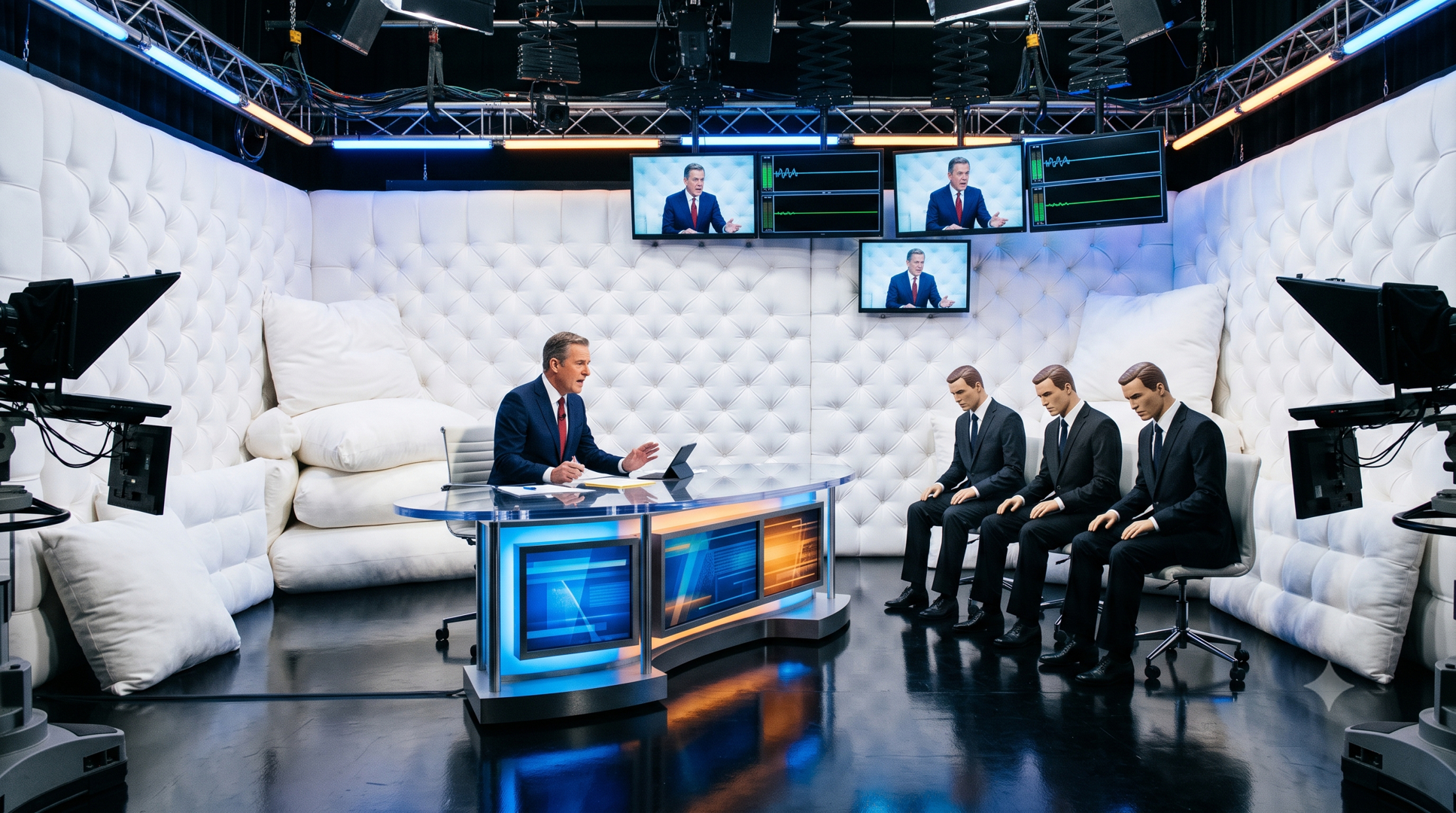
By: Adam Reuter
Credit where credit is due: thirty years ago this month, Rupert Murdoch and Roger Ailes did something the American media landscape desperately needed. When Fox News Channel launched in October 1996, the legacy press was a self-satisfied monoculture. ABC, CBS, NBC and CNN operated with an unspoken coastal consensus on what qualified as “respectable news.” Fox bent that monopoly over its knee, gave a microphone to stories Manhattan editors buried and proved that millions of Americans were starving for an alternative. 30 years later, the network is lighting up the Empire State Building and ringing the Nasdaq opening bell to celebrate its pearl anniversary as the undisputed king of cable ratings.
Yet the celebratory confetti cannot obscure the rot: the network has become a hollow, padded shell of its former self. That isn’t just an anecdotal gripe from nostalgic viewers—it is hard scientific fact. A landmark 2025 study titled “Disagreement is Disappearing on U.S. Cable Debate Shows” by computer science researchers S. M. Mehedi Zaman and Kiran Garimella took a computational sledgehammer to modern cable news.
Analyzing over 21,000 episodes, 24 flagship programs, and 2.13 million conversational turn-pairs between 2010 and 2024 across Fox, CNN, and MSNBC, the researchers proved that genuine on-air disagreement plummeted by roughly one-third between 2017 and 2024. Across modern primetime, explicit debate has collapsed to a pathetic 15% to 17% of all exchanges. The remaining 83% to 85% is pure, uninterrupted affirmation–a circle of nodding heads agreeing with the host’s premise.
The Two-Step Cable Lobotomy
The structural culprit behind this collapse is a cowardly production shortcut that has replaced live political combat across cable:
- Play a 10-second, out-of-context video clip of a political rival.
- Turn to a hand-picked panel of agreeable pundits who nod along and amplify the host’s indignation.
It is “debate by puppet show.” The prerecorded clip acts as a defenseless strawman that cannot push back, cannot clarify context and cannot punch the host in the mouth with counter-evidence. The panel functions as a yes-man choir, competing to deliver the sharpest applause line and reassuring the viewer that anyone outside the room is either a lunatic or an idiot.
The Ghost of the “Lion’s Den” and the Jesse Watters Exception
Compare that sterile assembly line to the network’s golden age. In the 2000s, The O’Reilly Factor wasn’t a safe space; it was a Roman colosseum. Bill O’Reilly was arrogant, talked over everyone, and famously barked at the control room to cut guests’ microphones when he was losing an argument. But his executive producer, David Tabacoff, operated an audacious booking desk.
They dangled 3 to 4 million live viewers in front of ideological enemies—ACLU directors, Barney Frank, Richard Dawkins, Camille Paglia, Al Sharpton—with a ruthless wager: come into the lion’s den, take O’Reilly’s heat for six minutes, and try to persuade our audience. Guests took the gamble because there were actual stakes. Barney Frank regularly left O’Reilly flustered on live television, and the audience was glued to the screen because real danger was in the room.
Today, Jesse Watters is practically the sole survivor carrying that old, unhinged shock-jock DNA. Having come up through The O’Reilly Factor‘s ambush-interview laboratory on the Watters’ World show segment, Watters understands that unpredictable conflict beats sanitized talking points every single time. When Michigan Democratic Senate nominee Abdul El-Sayed blindsided him on live television by asking whether he was circumcised, it was crude, hilarious, and bizarre—but it was electrifying because it completely shattered the corporate PR script. For a fleeting five minutes, live television felt alive again. See the 18 minutes timecode below (18:40 to be exact):
From Pelican Briefs to the Facebook Block Button
Fox News didn’t invent the retreat into an ideological bunker; they simply monetized it better than anyone else. The same disease has hollowed out the rest of the broadcast world:
- Howard Stern’s Corporate Scrub: The self-proclaimed “King of All Media” spent decades terrorizing Hollywood phoniness, fighting the FCC, and putting unhinged oddballs on live radio. Then came the infamous 2013 leaked staff summit—the “Pelican Brief”—where Stern ordered his team to make fake Twitter accounts to beg A-list celebrities for interviews. He brought in corporate efficiency guru Marci Turk, scrubbed decades of controversial bits from the SiriusXM replay vault, launched an apology tour to Ellen DeGeneres, and eventually locked himself inside a Southampton basement bunker to gently psychoanalyze Bruce Springsteen over Zoom.
- Tom Leykis and the Ban Hammer: Legendary shock jock Tom Leykis made millions on terrestrial radio by letting angry callers jump to the front of the queue so he could roast them over open lines. But when he moved to private digital streaming and Donald Trump scrambled the political board, Leykis lost his nerve. Instead of treating pushback from his working-class “P1” listener base as prime talk-radio friction, he retreated behind social media block buttons, banning loyal, paying fans from his feeds simply for disagreeing with his political rants.
The rule across modern media is universal: the second a broadcaster decides their peace of mind matters more than the friction of the broadcast, the show dies.
The Anti-Snowflake Irony
There is a delicious, biting irony in what Fox News has built for its 30th birthday.
For over a decade, the network’s primetime stars made fortunes mocking campus “snowflakes,” railing against academic safe spaces and ridiculing trigger warnings. They built a media empire on the slogan that facts don’t care about your feelings and that shielding people from uncomfortable ideas is pure cowardice.
Yet behind the studio cameras, those same producers constructed the most profitable, hermetically sealed safe space in American broadcast history. The modern primetime viewer is protected like an endangered orchid. God forbid a conservative viewer hear an articulate opponent make a compelling counter-argument. It is far safer–and far more lucrative–to feed the audience a steady diet of pre-chewed outrage where the home team never loses a scrimmage.
Happy 30th birthday to Fox News. Murdoch and Ailes broke the mold in 1996. But thirty years later, don’t insult our intelligence by calling it a news debate channel. Call it what Zaman, Garimella, and common sense have proven it to be: a multi-billion-dollar nursery where nobody ever gets their feelings hurt.