Why the Physics of the Renee Good Shooting Prove Agent Jonathon Ross Murdered Her
By: Adam Reuter
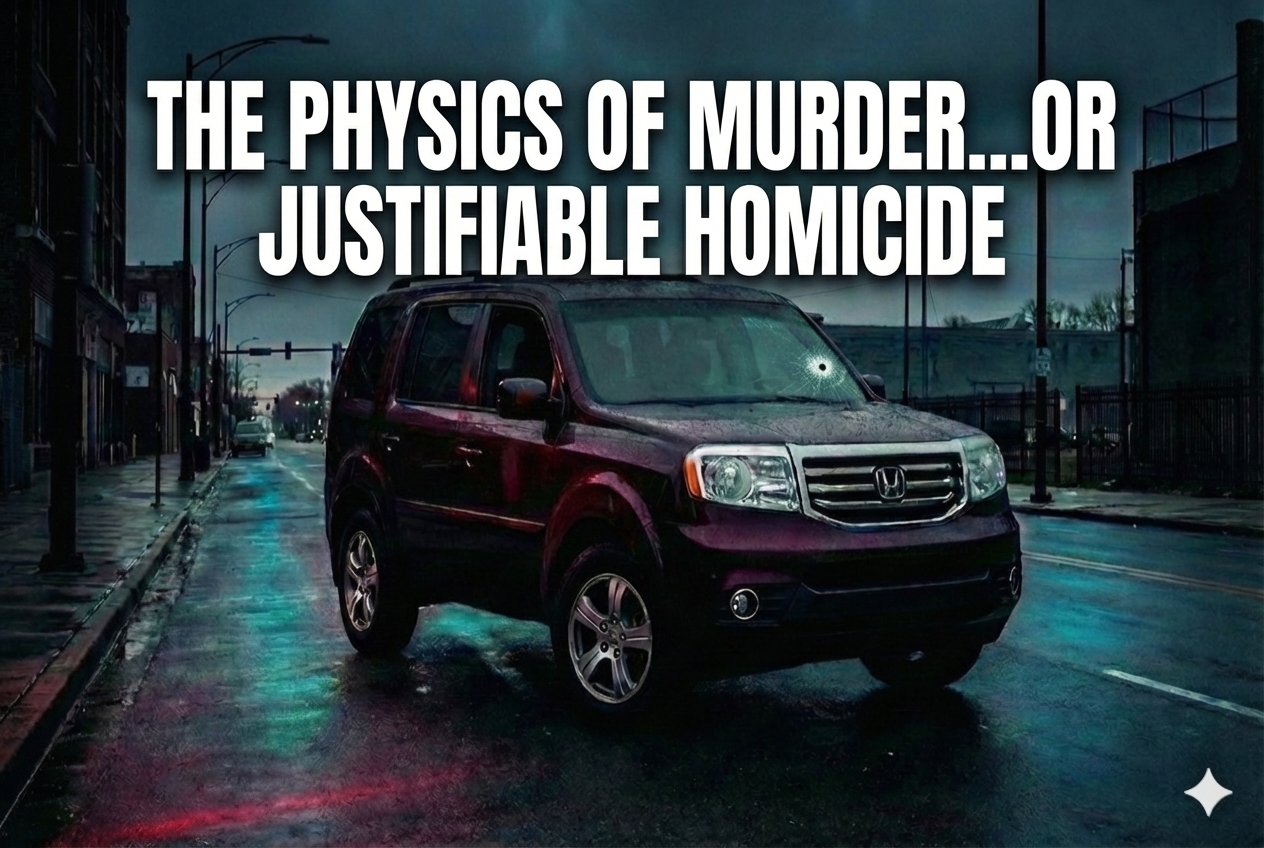
Let’s cut the BS about “split-second decisions” and “the fog of war.” Physics doesn’t lie. Geometry doesn’t have a union rep. And right now, the geometry of the bullet holes in Renee Nicole Good’s Honda Pilot proves ICE Agent Jonathon Ross committed a cold-blooded killing, not a tactical maneuver.
We know there were three shots fired. Based on a close review of the video and audio footage, the sequence is damning: One through the windshield. Then a pause. Then two through the driver’s side window.
Right now, Ross’ lawyers are praying for a specific result from the autopsy. They are playing a game of “Legal Roulette” with Renee Good’s body, and here is how it works:
The “What If” Game
- Scenario A: If the single bullet through the windshield was the fatal one, Ross has a defense. He will claim the SUV was a “deadly weapon” coming right at him. He’ll hide behind the “imminent threat” clause. It is a weak defense given the video, but it is a legal lifeline.
- Scenario B: If one of the two bullets through the side window killed her, Ross is toast.
Let me explain this like we’re five years old, because apparently, the DHS Force Review Board struggles with basic shapes. If you are shooting through the side glass, the car isn’t coming at you anymore. It is passing you. The bumper has cleared your hips. The threat of impact is zero.
If a side bullet killed her, the “self-defense” argument is dead. You cannot kill a driver for almost hitting you.
The Intent is in the Pause
But here is the truth that the courts need to hear: It doesn’t matter which bullet actually stopped her heart.
Even if the windshield shot was the fatal one, those two subsequent shots—the side window shots—prove Agent Ross wanted to commit a murder.
https://twitter.com/krassenstein/status/2009248665647419474/video/1
His lawyers will scream “Continuous Course of Conduct.” They’ll say it all happened in one burst, less than a second, and he couldn’t stop his finger. That is a lie. The cadence of the shots tells a different story.
Action -> Assessment -> Reaction.
- Shot One (Windshield): The SUV accelerates. Ross fires. This—arguably—is the “panic” shot.
- The Pause: There is a distinct, rhythmic break. A hesitation. In this fraction of a second, the SUV bumper clears his body. The immediate danger is gone.
- Shots Two and Three (Side Window): Ross pivots and fires twice more.
That pause is not a mechanical jam. It is a cognitive process. It is the moment Agent Ross’s brain switched from “Self-Defense” mode to “Execution” mode.
Physics dictates that to place two separate shots through a passing side window, you have to physically turn your torso. You have to pivot. You have to track the target.
That turn is a choice. The second trigger pull is a confirmation.
In that split second, Ross switched from “stopping a threat” to “punishing a fleeing subject.” He tracked her. He lined up multiple shots on a woman who was no longer a danger to him. That is not panic; that is predation.
The Hard Truth
Let’s be adults here. Should Renee Good have rolled up on federal agents in the middle of an ICE operation? No. She shouldn’t have been there. She shouldn’t have interfered. And her wife, Becca Good, definitely shouldn’t have been running her mouth, throwing insults at an armed federal law enforcement officer.
But being a nuisance isn’t a capital crime. Interfering with an investigation gets you handcuffs, not a hollow-point to the skull. In a court of law, “She shouldn’t have been there” is not a legal justification for “So I executed her.”
Manufacturing the Threat
Let’s be clear about the tactics here. Agent Ross walked toward a moving vehicle. In law enforcement, we call this “Officer-Created Jeopardy.” You cannot step in front of a train and then blame the conductor for the impact. By closing the distance on a vehicle that was clearly exiting the scene, Ross manufactured the crisis. He used his own body as a blockade, and when Renee Good refused to play his game of chicken, he decided she had to die. He didn’t shoot her to save his life; he shot her because–in my opinion–she didn’t yield to his authority.
The Motive
Why did he take those final, pivoting shots? The video tells us everything.
Seven seconds. That is the time between the insult and the execution.
Becca Good’s words were specific and cutting: “You want to come at us? I say go get yourself some lunch, big boy. Go ahead.”
You can’t miss the implication. And you can’t miss the reaction. Seven seconds later, Ross unloaded his weapon. And when the shooting stopped, Ross didn’t call for a medic. He didn’t gasp in relief.
He muttered, “Fucking bitch.”
That slur—caught on his own phone—connects the dots. It wasn’t fear. It was anger. He didn’t shoot Renee Good because he was afraid of her SUV; he killed the driver because she was disobeying orders and her passenger had just bruised his ego. It’s what we call “contempt of cop”—and he decided the penalty was death.
Agent Ross turned his body to fire those final rounds. Now, the justice system needs to turn on him. This wasn’t a “bad shoot.” It was an assassination with a badge.