Maryland AG Anthony Brown is Running a Shadow Organization on Your Dime
Why does the “Black Employees’ Network” have a budget but no public bylaws?
By Adam Reuter
If a private company wants to host racially exclusive parties for its staff, that’s their business (and their HR department’s nightmare). But when the Office of the Attorney General (OAG)—the state’s highest law enforcement agency—does it, it’s everyone’s business.
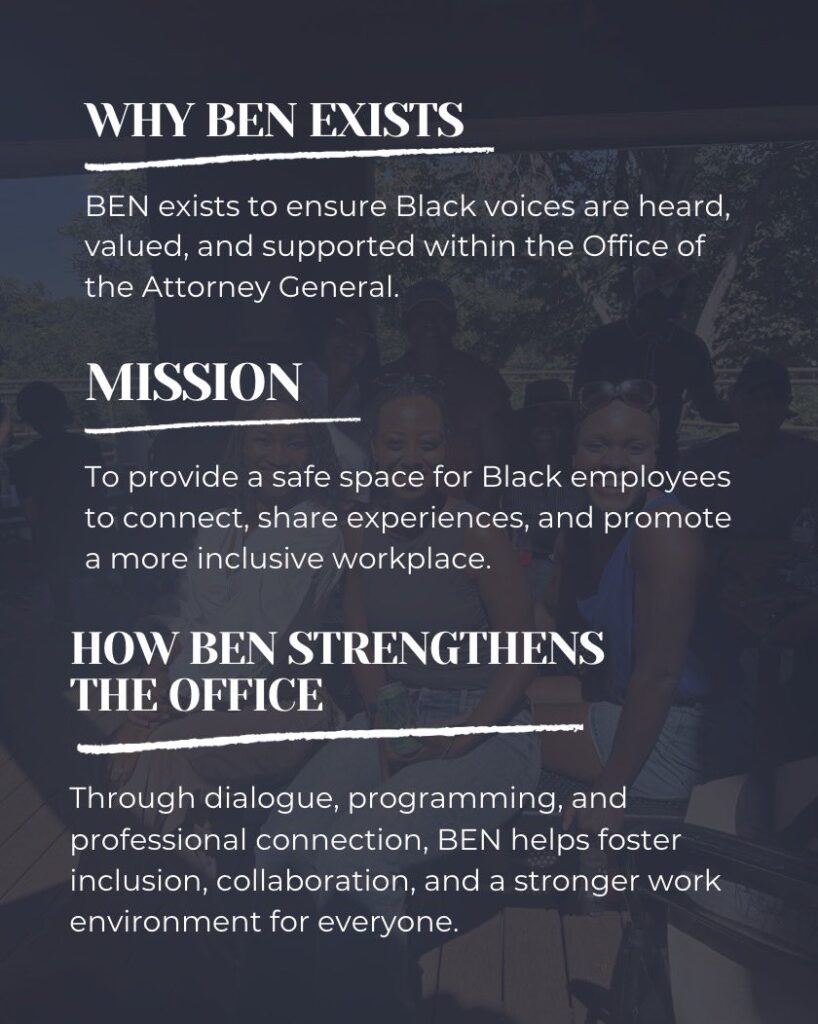
Today, Maryland’s Attorney General Anthony Brown publicly promoted the “Black Employees’ Network” (BEN) across social media, boasting that the group exists to create a “safe space for Black employees” and “ensure Black voices are heard.”
The Attorney General’s office wants you to believe that the Black Employees’ Network is a vital lifeline for a marginalized group. The data says otherwise. According to Maryland’s own FY2024 Equal Employment Opportunity Report, African Americans are the largest racial demographic in the state Executive Branch at 45.26%—outnumbering White employees (43.44%) and dwarfing Hispanic (2.14%) and Asian (2.89%) staff. When the largest power bloc in a government agency demands a ‘safe space’ from everyone else, that isn’t progress—it’s the institutionalization of tribalism on the taxpayer’s dime.
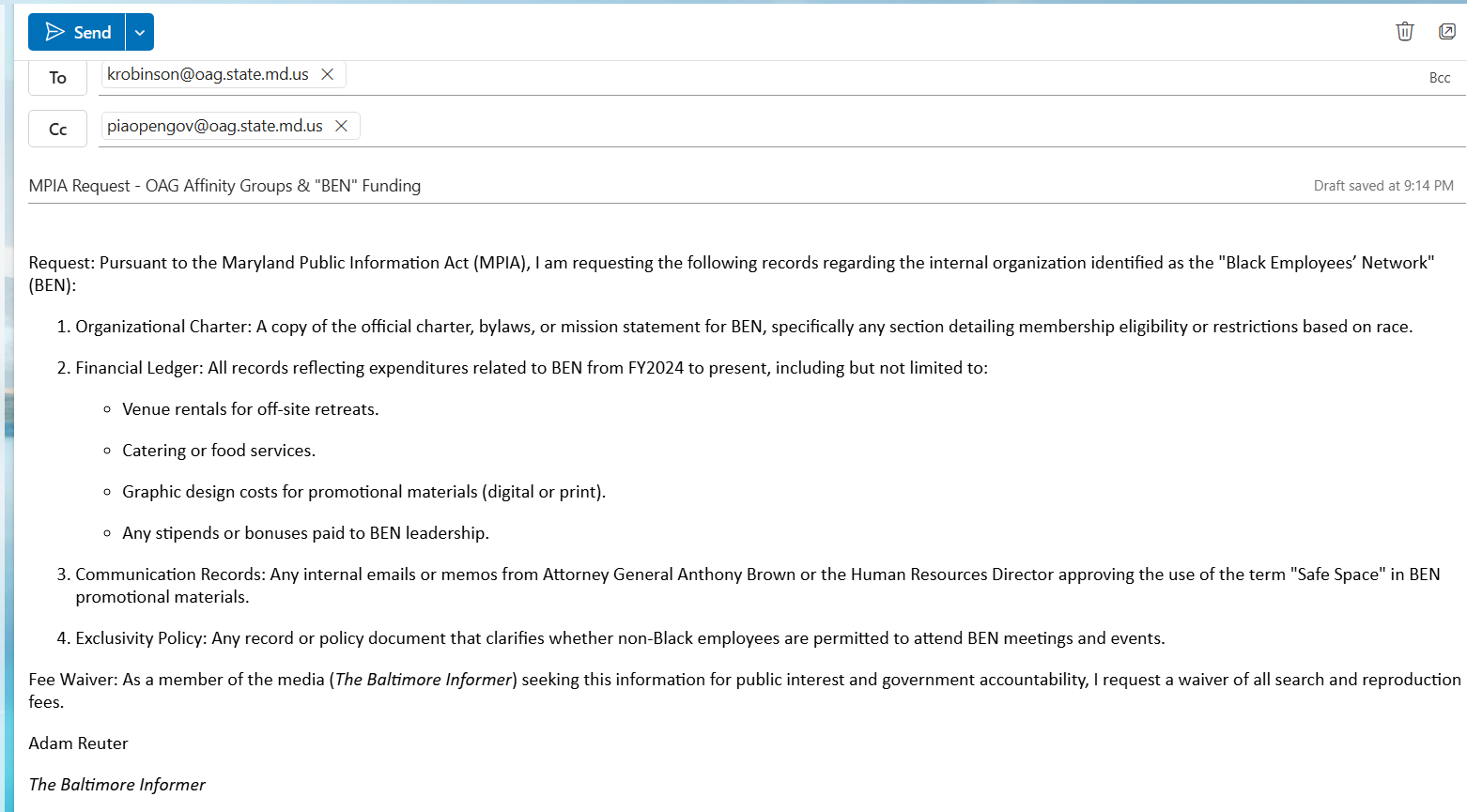
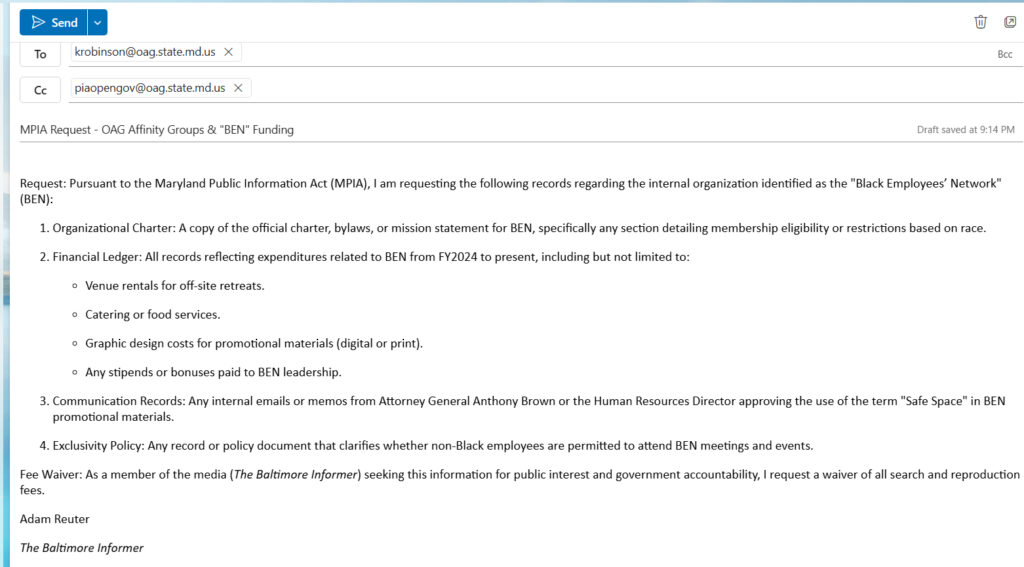
Whatever their intentions, the optics are disastrous: The state’s top lawyer is effectively endorsing a racially segregated affinity group. I have formally requested the bylaws and budget from the OAG via an MPIA request. If they have nothing to hide, they’ll produce them. If they stonewall, we’ll know why.
But the real scandal isn’t what’s on the flyer. It’s what isn’t.
The Ghost in the Machine Go to the Maryland Attorney General’s official website. Search for “Black Employees’ Network.” Search for “BEN.”
You will find nothing. Zero.
There are no bylaws. There is no mission statement. There is no board of directors listed. There is no budget line item.
Yet, this “ghost” organization seemingly has access to state resources. Who paid for the graphic design of their marketing materials? Who paid for the venue of the retreat featured in their photos? Are the “leaders” of this network conducting this business on state time, while drawing a state salary paid for by taxpayers of all races?
Rules for Thee, But Not for Me
Attorney General Brown has built his entire brand on “equity” and “transparency.” He demands that police departments and private businesses open their books and account for every decision regarding diversity.
Yet, inside his own house, he is operating a race-based network that functions with zero public transparency.
If BEN is an official government body, where are the meeting minutes? The Open Meetings Act requires public bodies to be transparent. If BEN is not an official government body, why is it using the OAG seal and being promoted on official government social media channels?
You cannot have it both ways. You cannot be a “private club” when you want to exclude people, and a “government entity” when you want to use tax dollars.
The irony here is thick enough to choke on. Almost exactly one year ago, in February 2025, Attorney General Brown led a coalition of 16 Attorneys General to issue formal guidance explicitly defending the legality of Diversity, Equity, and Inclusion (DEI) policies. In his own press release, Brown argued that initiatives like Employee Resource Groups are ‘essential for creating fair, thriving workplaces’ and help organizations ‘comply with the law.’ He even lectured the private sector that these groups must be ‘inclusive’ to be legal.
So, here is the question for the Attorney General: If you are so confident that race-based employee networks are the gold standard of legal compliance, why are you hiding yours? You don’t scrub the internet of an organization you are proud of. You don’t hide the bylaws of a group that is ‘essential.’ Brown is publicly championing the legality of DEI while simultaneously running an internal network that operates with all the transparency of a secret society. He knows the law requires these groups to be open to all—which effectively makes his ‘Safe Space’ flyer a confession of non-compliance.
The “Safe Space” Trap
The OAG’s own promotional material claims BEN provides a “safe space for Black employees.” In employment law, a “safe space” typically implies exclusivity.
The Pendulum Has Swung: Ames v. Ohio (2025)
To anyone claiming that “historical context” justifies modern segregation, the Supreme Court has a message for you: The law doesn’t care about your history lesson anymore.
In June 2025, the Supreme Court issued a unanimous decision in Ames v. Ohio Department of Youth Services that fundamentally changed the landscape of employment law. For decades, courts often required white or male plaintiffs to jump through extra legal hoops (showing “background circumstances”) to prove discrimination—effectively a legal double standard that tolerated “reverse discrimination.”
Ames killed that double standard.
Writing for a unanimous Court, Justice Ketanji Brown Jackson explicitly ruled that Title VII “draws no distinctions between majority-group plaintiffs and minority-group plaintiffs.” The Court held that the law “left no room for courts to impose special requirements on majority-group plaintiffs alone.”
This ruling destroys the Attorney General’s defense. If the OAG is providing a “safe space” for the majority (Black employees) while excluding the minority (White or Asian employees), they can no longer hide behind “historical context.” Under Ames, discrimination against a white employee is now legally identical to discrimination against a black employee. Anthony Brown is running a 1960s-style exclusion racket in a post-Ames world, and the liability is massive.
So, here is the question for Attorney General Brown: Can a White, Hispanic, or Asian employee join BEN?
- If the answer is “No”: Then the Attorney General is presiding over a violation of Title VII of the Civil Rights Act, which forbids segregating employees by race.
- If the answer is “Yes”: Then why advertise it as a “safe space” for one specific race?
It is time for the OAG to stop playing identity politics with public funds. The citizens of Maryland deserve an Attorney General focused on justice for all, not special interest clubs for some.
DATA DEEP DIVE: The “Majority” Safe Space
Source: Annual Statewide Equal Employment Opportunity Report – Fiscal Year 2024.
According to the official 2024 demographic audit of the Maryland Executive Branch workforce, the very demographic the Attorney General claims requires a “safe space” for their voices to be heard is, in fact, the statistical majority.
| Race/Demographic | Percentage of State Workforce |
| African American | 45.26% |
| White | 43.44% |
| Asian | 2.89% |
| Hispanic/Latino | 2.14% |
| Multiracial | 1.23% |
| Unidentified | 4.67% |
The Bottom Line:
- The Power Bloc: African Americans are the largest racial group in the state government workforce.
- The Gender Gap: Women comprise 56% of the workforce.
- The Diversity Reality: “Minorities” (as defined by the state) collectively represent over 52% of all state employees.
If the goal of the OAG’s “Black Employees’ Network” is to protect a vulnerable or underrepresented minority, the state’s own data suggests they are protecting the majority from the minority. Under Title VII, providing exclusive professional networking and “safe spaces” to the dominant demographic while excluding others is a textbook definition of institutional discrimination.