War Chests, Gatekeepers, and Goucher: Why the Media Better Not Fail the 2026 Candidates Like They Failed Me OP-ED
By: Adam Reuter
The 2026 race for Baltimore County Executive is barely out of the starting blocks, and the headlines are already telling you who matters. But if you look closely, they aren’t telling you who has the best ideas, who understands the zoning code, or who actually gives a damn about Dundalk or Towson.
They are telling you who has the money.
We are seeing the reports roll in: Julian Jones is sitting on a mountain of cash. Izzy Patoka is right behind him. The narrative is already being cemented by the “Big Media” outlets that the person with the biggest “war chest” is the person who deserves your attention.
I know this game because I’ve been on the losing end of it. When I ran for County Executive in 2022, I saw firsthand how the money-grubbing media apparatus operates. They don’t vet candidates based on intelligence, policy, or passion. They vet them based on their bank accounts. If you don’t have a six-figure balance or a rolodex of developer donors, you don’t exist to them.
Their favorite excuse is “resources.” They claim newsrooms are shrinking, budgets are tight, and they simply don’t have the time to cover every “fringe” candidate who files paperwork. They hide behind terms like “viability” and “newsworthiness” to justify lazy journalism.
Let me tell you why that is absolute garbage.
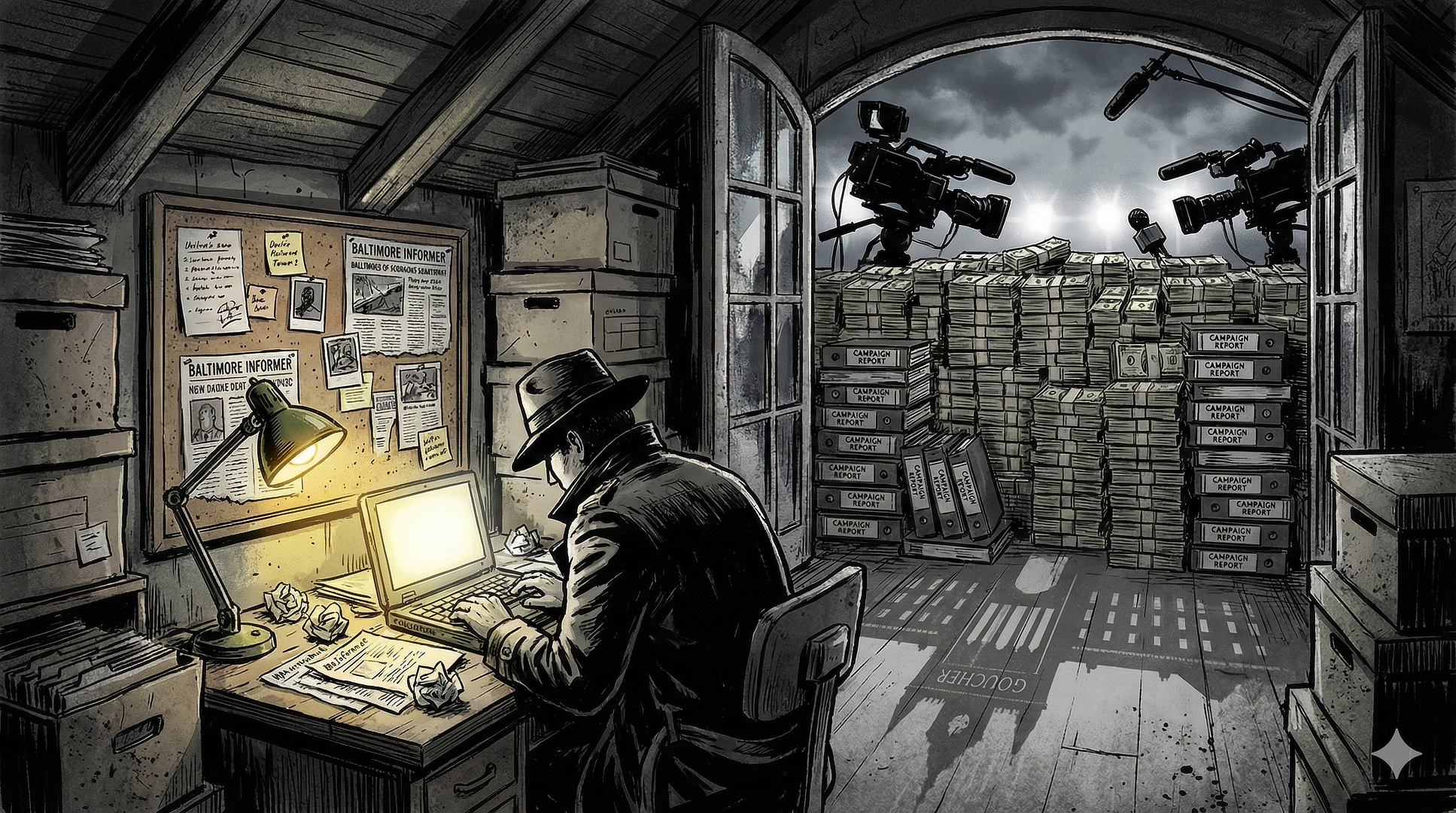
I run the Baltimore Informer out of an attic on a shoestring budget. I am a one-man operation. Yet, I manage to sit down, interview candidates with high quality audio (and sometimes video!), dissect policies, and put information in front of voters. My philosophy is simple: Anyone who has the guts to stick their neck out and run for public office is newsworthy.
Period.
If I can produce a news site and podcasts from an attic with zero budget, the Baltimore Sun, the Banner, and the TV stations have zero excuses.
When they refuse to cover the “little guy,” they create a self-fulfilling prophecy. You can’t raise money if you aren’t in the news, and you can’t get in the news if you haven’t raised money. It is a closed loop designed to protect the establishment.
And it’s not just the newspapers; it’s the pollsters, too. In 2022, there was never a public poll pitting me against Johnny Olszewski. Why? Because Goucher College—the gold standard for local polling—seems to be in the business of kissing alumnus Johnny O’s behind rather than measuring actual voter sentiment. By refusing to even include challengers in the polling questions, they tell the voters, “This person isn’t real.” It is suppression by omission.
Goucher College loves to talk about Diversity, Equity, and Inclusion (DEI). Their website is full of lofty promises about “championing an inclusive community,” “respecting different perspectives,” and “addressing power and privilege.”. They even have a specific mandate in their “Race, Power, and Perspective” curriculum to explore the “power structures behind differences”. Goucher chose to exclude me from their polling questions entirely. There was no head-to-head matchup of “Olszewski vs. Reuter.” To Goucher, I didn’t exist.
Why does this matter? Because polling isn’t just a measurement; it is a power structure. When an institution like Goucher decides who is “viable” enough to be polled, they are actively participating in the very systems of privilege they claim to dismantle. They are saying that only candidates with massive war chests (wealth privilege) or establishment backing (institutional power) deserve to be seen by the voters. Actions speak louder than words…the upcoming Baltimore Informer Poll will include ALL local candidates.
Now, look at 2026. We have Nick Stewart pushing reform and Pat Young utilizing the public financing system—a system meant to level the playing field. Yet, the media coverage still fixates on the cash gap between them and the establishment favorites like Jones and Patoka.
The media has a choice to make this cycle. They can continue to be PR agents for the candidates with the deepest pockets, acting as gatekeepers who decide who “viability” applies to. Or, they can actually do their jobs.
They can stop looking at finance reports and start looking at platforms. They can stop pretending that “newsworthy” means “rich.” They can give the microphone to every candidate on the ballot, not just the ones buying advertising space.
I learned my lesson in 2022. If I ever run again, I know the game is rigged. But for the sake of the county, the 2026 candidates deserve better. And if the big outlets won’t give them a fair shake, the Baltimore Informer will.